



Published in Indian Express 19th July 2026
Two years ago, my daughter Raya took her first international trip. We chose something off-beat. We went to Georgia.
Not the American state. The country. The one wedged between Europe and Asia, on the edge of the Caucasus mountains, that most Indian travellers haven’t seriously considered visiting yet. And I can tell you now, looking back, that it was exactly the right call. Not just as a trip, but as a first introduction to what the world outside India can feel like.
We did Tbilisi, Kakheti, and Kazbegi. Ten days that rearranged something in my head about where the most interesting travel experiences actually live. Because here’s the thing I keep coming back to: the two oldest wine-producing civilisations on earth are not in France. They are not in Italy. They are in Georgia and its neighbour Armenia. Two nations that were making wine when the pharaohs were still building pyramids, that adopted Christianity before the Roman Empire did, and that have a food and hospitality culture so elaborate it would make an Indian wedding caterer nod in recognition, well almost.
I have done one half of the Caucasus. Armenia is still on my list. But between what I have seen and what I have read, I’m convinced that this is a very interesting corner of the world travel map that you shouldn’t continue to ignore. Let me tell you why.
Georgia: Where the Feast Is the Point
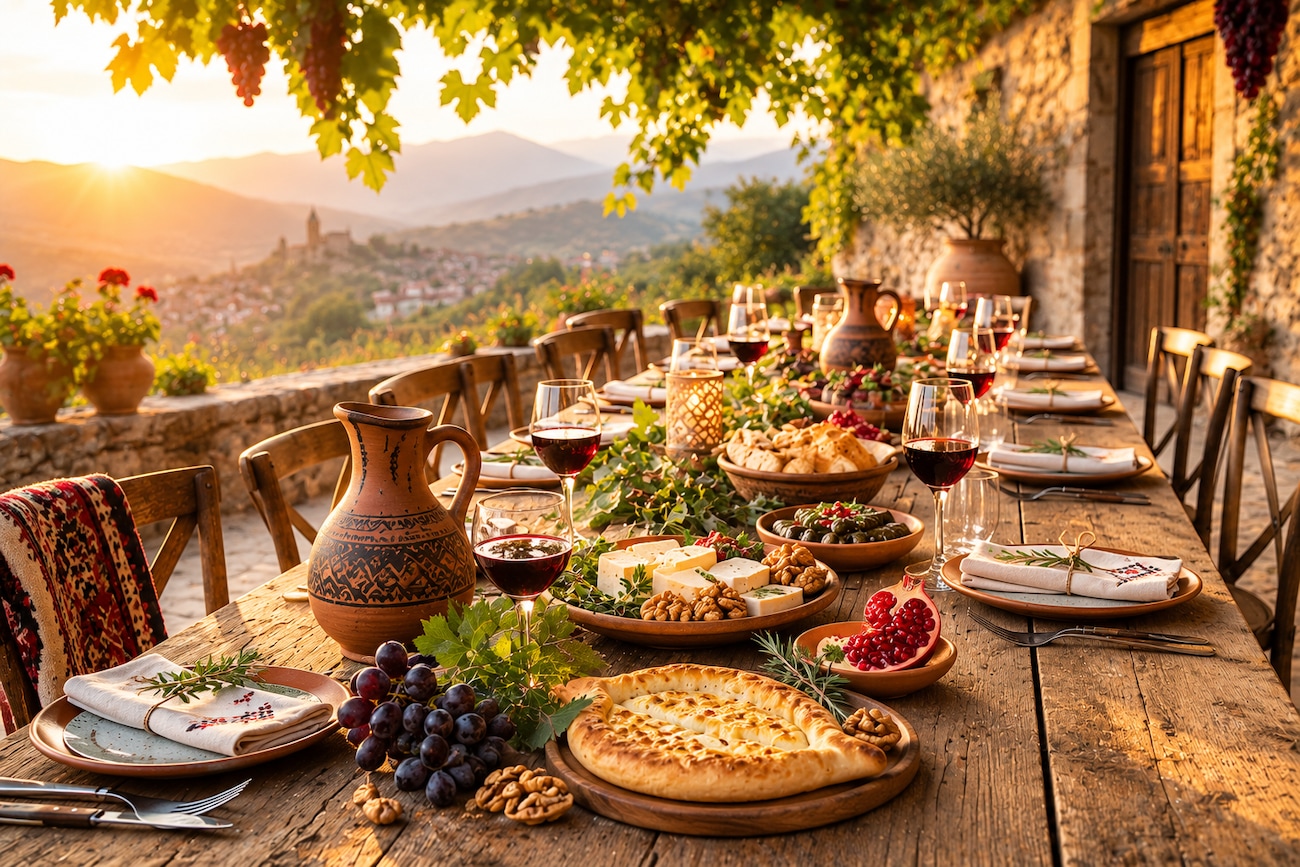
I need to start with the supra, because nothing prepares you for it. A supra is a traditional Georgian feast, and once you have been to one, you understand the country. There’s a designated toastmaster called a tamada who leads the table through a series of elaborate toasts. To family, ancestors, friendship, the land, and the guests. The food doesn’t stop. Khachapuri, a cheese-filled bread so central to Georgian life that the national statistics office literally tracks its price the way we track the consumer price index. Khinkali, soup dumplings with a built-in drinking ritual: hold the top knot, bite a small hole, sip the broth, eat the dumpling, leave the knot on your plate so everyone can count how many you’ve had. Walnut-paste salads, grilled meats, churchkhela which is a walnut-and-grape candy that looks like a candle and tastes like nothing you’ve eaten before. And through all of it, wine.
Georgia has been making wine for 8,000 years. That’s not a rounded number for effect. Archaeological evidence dates Georgian winemaking to 6000 BC, making it the oldest continuous wine culture on the planet. The traditional method uses qvevri: large clay vessels buried underground, where grape juice ferments with the skins and seeds still in it. The result is amber wine, a category that barely exists outside the Caucasus. UNESCO now protects the method as an Intangible Cultural Heritage. Georgia has over 430 indigenous grape varietals, more than almost any country on earth.
We spent a few days in Kakheti, Georgia’s wine country, and this is where the numbers become personal. Almost every household in the region makes its own wine. You visit a family, and within minutes you are in their cellar, tasting from qvevri their grandfather buried. The wine isn’t for sale. It’s for you, because you showed up, and in Georgia, a guest is considered a gift from God. That’s not a tourism slogan. It’s a proverb theyactually live by.
Tbilisi is a city that feels like it couldn’t decide between Europe and Asia, so it chose both. Sulphur baths from the Persian era sit next to crumbling Art Nouveau balconies from the Russian period. A 4th-century fortress overlooks a skyline of glass-and-steel modernity. The old town is a maze of narrow lanes where wine bars serve natural wines alongside cheese so fresh it squeaks.
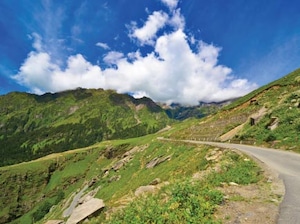
And then, Kazbegi. The drive up the Georgian Military Highway, through the Greater Caucasus, is one of the most spectacular road journeys I have done anywhere. And at the end of it, the Gergeti Trinity Church, perched on a hilltop at over 2,000 metres with Mount Kazbek’s 5,054-metre glacier behind it. Raya and I stood there, not saying much, because there wasn’t much to say. Some views just close your mouth for you.
Armenia: The Country I Haven’t Been To Yet
And now, the other half. The half I haven’t seen but can’t stop reading about. Armenia was the first country in the world to adopt Christianity as its state religion, in 301 AD. Thirty years before Georgia and a full decade before the Roman Emperor Constantine converted. Yerevan, the capital, was founded in 782 BC, which makes it older than Rome by 29 years. The entire landscape is scattered with monasteries and churches that predate most of European civilisation.
And some of them sound extraordinary. Geghard Monastery is partially carved directly into a cliff face, with chambers hollowed from the rock where monks lived and prayed in near-total darkness. The acoustics inside are reportedly so precise that a single voice can fill the entire space. The Wings of Tatev, the world’s longest reversible cable car, carries you 5.7 kilometres across the Vorotan Gorge to reach Tatev Monastery, which has been sitting on the edge of a canyon since the 9th century. Khor Virap, a monastery at the foot of Mount Ararat, gives you what might be the most iconic view in the entire Caucasus: the monastery in the foreground, the sacred mountain rising behind it, and the uncomfortable knowledge that Ararat, Armenia’s holiest symbol, actually sits across the border in Turkey.
The food, from everything I have read and heard, is extraordinary in a different register from Georgia. Where Georgia is cheese and wine, Armenia is smoke and stone fruit. Khorovats, the Armenian barbecue, is a national obsession: marinated meat grilled over grapevine coals, the smoke carrying a fragrance that doesn’t exist anywhere else. Lavash, the traditional flatbread baked by slapping dough against the walls of a clay tonir oven, is so culturally significant that UNESCO gave it intangible heritage status. Dolma, ghapama (a stuffed pumpkin served at celebrations), and a cuisine built on herbs, walnuts, pomegranate molasses, and dried apricots. And then there’s the brandy.
Armenia makes what might be the most underappreciated spirit in the world. Ararat brandy has been produced since 1877, and there’s a story about it that I can’t get out of my head. At the Yalta Conference in 1945, where Churchill, Roosevelt, and Stalin were carving up the post-war world, Stalin poured Churchill a glass of Ararat Dvin after dinner. Churchill was reportedly so taken with it that he had cases shipped to him for years afterwards. The legend says the quality dipped at one point, Churchill complained to Stalin, and Stalin discovered that the brandy master responsible had been exiled to Siberia. The man was brought back. Whether every detail is accurate or slightly embroidered over the decades, the spirit itself is real, it’s remarkable, and you can visit the distillery in Yerevan and taste expressions aged up to 70 years.
That’s the kind of thing that makes Armenia pull at you. Every fact leads to another fact, every story opens a door to a deeper one.
Two Countries, One Story
Here’s what makes Georgia and Armenia work so well together, and why I’d tell any Indian traveller to visit them as a pair.
They are the two oldest Christian nations on earth, and yet their versions of Christianity are different. Georgia is Orthodox, Armenia is Apostolic, following its own ancient path. The churches look different, the rituals feel different, and the role religion plays in daily life has a different texture in each country. Having seen the Georgian side, I know the Armenian side will land differently because I’ll have something to measure it against.
They both claim to have invented wine, and both have the archaeology to back it up. Georgia points to 8,000-year-old grape residue in clay vessels. Armenia points to the Areni-1 cave, where a 6,100-year-old winery was discovered, complete with a wine press, fermentation vats, and storage jars. I have done the Kakheti wine region. The Areni valley is next.
They are both small and compact. Georgia is roughly the size of Ireland. Armenia is smaller than Belgium. You can see the highlights of both in ten to twelve days without feeling rushed. They are affordable in a way that Western Europe has forgotten how to be. A full Georgian meal with wine for two can cost less than a single entree in Paris. Armenia is even more accessible.
And here’s what, as an Indian traveller, I keep coming back to: the hospitality. In both countries, hosting a guest isn’t a commercial transaction. It’s a point of honour. The Georgian supra, where the tamada toasts to your health, your family, and your ancestors, felt remarkably similar to the way an Indian family welcomes someone into their home. The Armenian insistence on feeding you until you physically cannot eat any more will be familiar to anyone who has ever visited any Indian household. There is a warmth in the Caucasus that goes beyond politeness. It’s cultural. It’s structural. And for Indian travellers who have grown used to being treated as tourists first and guests second, this region is a reminder that not every part of the world has forgotten the difference.
What Stays With You
I’ll end with this. There are places you visit for the photographs, and there are places you visit for the feeling. Georgia was a feeling place. The taste of amber wine from a clay vessel in a family cellar in Kakheti. The echo of wind at Gergeti, 2,000 metres up, with Raya standing next to me, quiet for once. The supra that started at eight and ended at midnight, with the tamada’s final toast still ringing in my ears.
Armenia, I suspect, will be the same. The hymn in a rock-cut monastery. Mount Ararat at sunrise, impossibly large, impossibly close, impossibly not yours. A glass of brandy with a century of history in it.
I have seen one half. The other half is waiting. And these are places that know how to wait, they have been here for 8,000 years.
Know the Unknown
Ever since we launched flight bookings on Veena World, I have been disappearing down rabbit holes about flight routes, airport quirks, and things you can only see from 35,000 feet. This week's find genuinely surprised me.
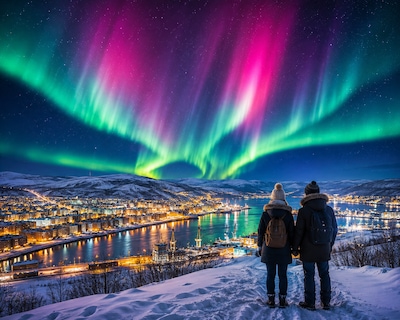
Most people spend lakhs standing in a field at minus fifteen degrees hoping the Northern Lights show up. Here's what nobody tells you, you can see them from your airplane seat. Los Angeles to Helsinki, New York to Reykjavik, Tokyo to London. These flights cross the aurora zone at night, at 35,000 feet, above the clouds, above the light pollution. Passengers describe it as flying through a curtain of green and purple while the cabin sleeps.
And right now is the moment. The sun just hit one of its strongest peaks in decades, making this the best aurora window in eleven years. It closes in 2027. North-facing window seat. Lights off. September to March. So what’s your pick to see the Northern Lights? From the ground or from 35,000 feet? See you next week….






 83 videos












Post your Comment
Please let us know your thoughts on this story by leaving a comment.