



Published in Indian Express 25th October 2026
i talk about smart travel all the time. Pack light. Carry one bag if you can. Choose the right month, the right seat, the right neighbourhood. For years that advice came easily, because for years it was largely true, and I could follow it myself. But today, when I think about it, a lot has changed.
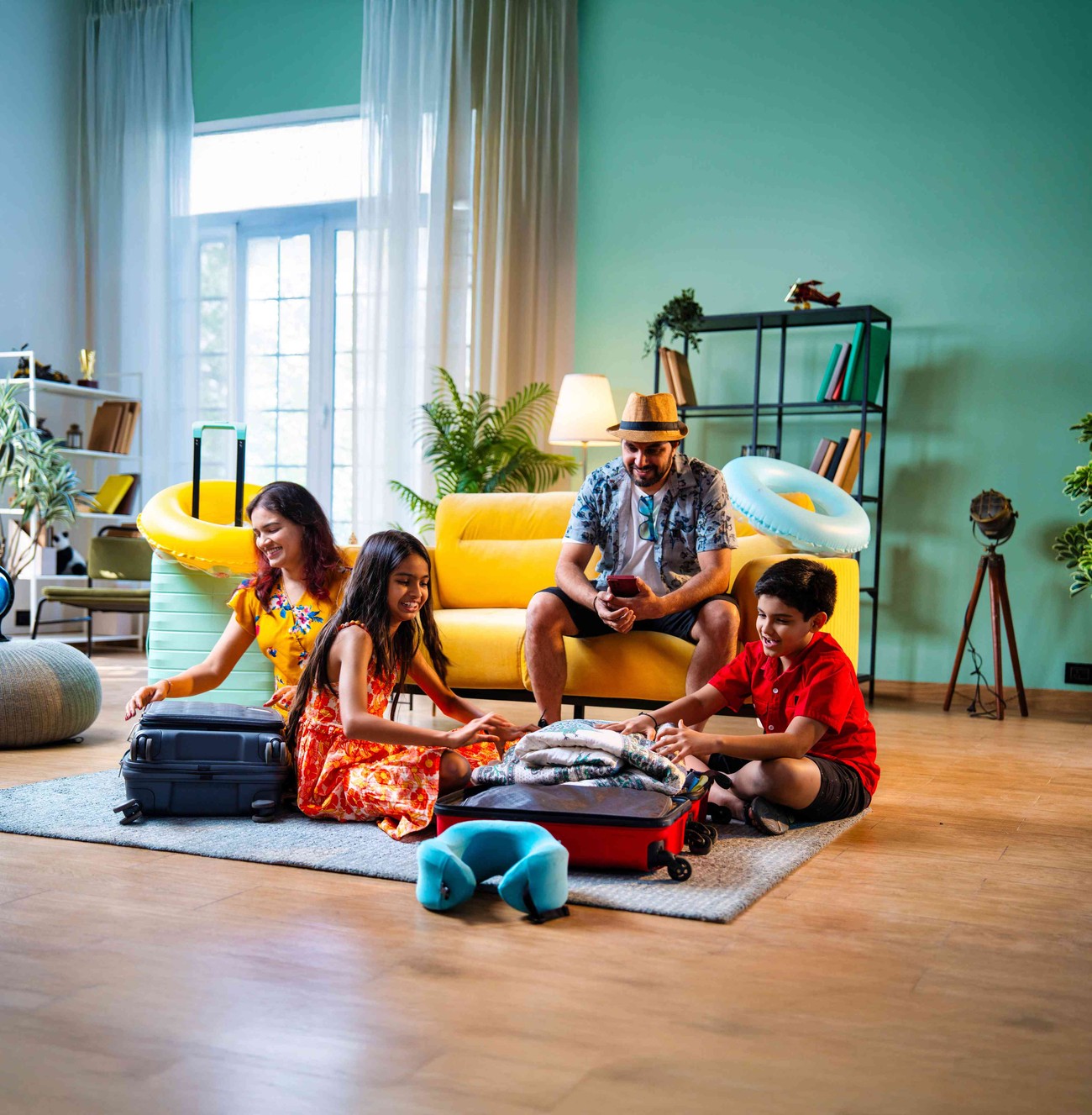
First Raya was born. Then Aarav was born, we became a family of four, and I have had to admit something. Smart travel and packing for four do not quite go together. The principles survive. The suitcase does not.
What the Numbers Say
Raya, now 2 years old, has been travelling since she was 3 months old, and she has not slowed us down. I keep a list of her journeys, and it now reads like the record of a seasoned traveller. Thirty-nine flights across twelve airlines. Twelve countries, starting with India and moving through the UAE, Georgia, Switzerland, the United Kingdom, Spain, Hong Kong, Thailand, Turkey, and most recently Montenegro, Croatia, and Bosnia and Herzegovina. Thirty-six cities and thirty places to stay, ranging from resorts to a fort hotel to a few apartments. Six Indian states. Seven train and metro journeys, including a Vista Dome to Pune, the London Underground, the Madrid Metro, and the Iryo high speed train between Madrid and Barcelona, along with two ferry crossings between Mumbai and Alibag. She has flown on an A350, a Dreamliner, a Boeing 777, and an Embraer 195 into Tivat. The list begins with a short hop from Mumbai to Udaipur and, for now, ends in Sarajevo.
Aarav’s list has barely started, but in his six months, he has visited 2 states and 4 countries. And that means that he is already part of the packing. And what I have noticed, looking at Raya’s list, is how much of it was not luggage at all. It was variety. Every journey on that list asked something different of a suitcase.
What One Child Taught Us
The first thing a list like that teaches is that no two journeys pack alike. A Vista Dome to Pune needs a bag you can reach in a minute. A long flight to Hong Kong needs a bag that holds up for hours. A regional jet like the Embraer into Tivat has less overhead space for anything extra. We learned to pack for the journey first and the destination second.
The second lesson is that twelve airlines mean twelve sets of rules. Infant allowances, strollers, bassinets, and baggage limits are not the same everywhere, and assuming they are is the quickest way to a difficult conversation at a check-in counter. Most airlines allow a folding stroller to travel at no charge and give infants a small baggage allowance, but the details vary, so the first step in packing is to read the airline’s rules, not to guess them.
The third lesson is the one that matters most now. With one child, there is usually a spare pair of hands. With two, there is not.
The Real Constraint Is Hands
This is the part nobody warns you about. Packing for four is not really a weight problem. It is a hands problem. Two adults, one child who walks and one who does not, two strollers, a carrier, a bag with everything that cannot be lost, and somewhere in all of that, a bag with the passports.
I was reminded of this at Tivat airport recently, which has no trolleys at all. Every bag has to be carried, pulled, or pushed by hand, from the baggage belt to the car. Now imagine arriving there with two children, strollers, and all the luggage that comes with them. That is the nightmare I am trying to avoid.
The arithmetic is unforgiving. Every extra suitcase is something one of you has to push, pull, or watch, at a moment when both hands are already full. So the rule I have settled on is simple. Anything that cannot be wheeled, worn, or carried without using a hand does not come.
The first thing the rule threw out of the window was the laptop. I have now done many of my trips without one, and it is quite easy. The smartphone can do almost everything I need it to, and a laptop that sits in the bag is simply extra weight, an extra charger, and one more thing to keep track of. Every extra piece of luggage adds to your mental stress, not just your physical load, and the laptop turned out to be the easiest piece to give up. It will not suit every job or every kind of trip, but for most holidays it is a rule worth trying.
What I Am Doing Differently
Pack by function, not by person: For years we packed one bag per person, which works when everyone can look after their own. With four, it fails. A better way is to divide the luggage by when it is needed. One bag for the journey itself, kept within reach. One bag for the first hour at the destination. And the main suitcases, which can stay in the boot or the hotel room until later. The bag that holds what you need in the first hour should never be at the bottom of a pile.
Carry what cannot be replaced. Buy the rest there: Nappies, wipes, and most baby supplies can be bought almost anywhere. What cannot be replaced easily is a specific medicine, a particular formula or food, a comfort toy, and the documents. Those go in the carry-on, along with a change of clothes for each child and, I have learned, one for each adult. A single spill at altitude can ruin a flight for two people.
Choose the stay for what it removes: A lift, a cot, a kettle, a refrigerator, and above all a washing machine remove more weight from a suitcase than any packing trick. With laundry available, you can pack for three days of a ten day trip. This is why a well serviced hotel or apartment beats a beautiful room for a family with a baby, even though the room looks better in photographs.
Fewer places, longer stays: This is the most important change, and it has nothing to do with the suitcase. Raya’s list has thirty-six cities on it, and I am proud of that. But the pace that produced it will not carry over unchanged. Every move between hotels means packing and unpacking four people’s belongings, and a baby does not care about the itinerary. Smart travel for four is less about the bag and more about staying put long enough that the bag does not have to move.
Pack the last day on purpose: I wrote recently about the last day of a trip and how easily it gets wasted. With a family of four the problem doubles, because every hour between checkout and the airport has to be worked out around luggage and a baby’s schedule. Plan it before you leave, not on the morning.
The Bag That Never Leaves My Hands
If I could keep only one bag, it would be this one. It is the carry-on that stays with us from the front door to the hotel room, and it is packed more carefully than anything else we take.
It holds all important travel documents, a power bank and the chargers, and any medicine we cannot afford to be without. It holds enough baby supplies for a full day, because checked luggage can be late and a baby cannot. It holds a change of clothes for each child and one for each adult. It holds a small handful of comfort toys, a few snacks, and a light blanket, because cabins are colder than anyone expects at three in the morning. Everything else can be replaced in an hour. Nothing in this bag can.
The test I use is simple. If the checked bags disappeared for a day, we should still be able to manage a comfortable evening and a calm morning. If we can, the bag is right.
Smart Travel, Redefined
I used to think of smart travel as travelling light. I now think of it as travelling with what you can actually manage. For a single traveller, the two are the same. For a family of four, they are not, and the second definition is the useful one.
It also means accepting that some of my own advice no longer applies to me. I cannot just have carry-on luggage and no check-in bags for four, and I will not try. What I can do is keep the principles that matter, which are to plan around the journey, to stay longer in fewer places, and to protect the days that carry the memories.
Aarav’s list is small for now. I do not know yet what his list at two years old will look like. What I do know is that he has already changed the way we pack, and that the next list will look different from Raya’s. I suspect it will be better planned, a little slower, and, if we manage it properly, a good deal lighter than the luggage would suggest.
Know the Unknown
Ever since we launched flight bookings on Veena World, I have been falling down rabbit holes about airports and the things we carry through them. And since this week’s piece is about travelling with only so many hands, here is the story of the invention that made it manageable.
Humans walked on the Moon in July 1969. The wheeled suitcase arrived the following year.
The wheel is roughly 5,500 years old, and for most of that time travellers carried their bags by hand, or paid someone else to. It was not until 1970 that Bernard Sadow, an executive at a Massachusetts luggage company, applied for a patent on a suitcase with four small casters and a strap to tow it by. His patent noted that large modern terminals had made baggage handling a real difficulty for air passengers. Department store buyers turned him down repeatedly, and the common reaction was that nobody would ever pull a suitcase on wheels. Macy’s began selling it in October 1970.
Sadow’s bag rolled flat and tended to wobble. The version we use today came in 1987, from an unlikely place, the cockpit. Robert Plath, a Northwest Airlines pilot, built an upright bag in his garage with two wheels and a telescoping handle, and sold the first ones to fellow pilots and flight attendants. Passengers saw crew members gliding through terminals with them and wanted the same, and Plath left the airline to start Travelpro, which sold the bag as the Rollaboard.
It is worth remembering the next time a terminal feels endless, or when an airport such as Tivat has no trolleys at all. Every wheeled bag in the building exists because a pilot grew tired of carrying his own, and because it took nearly two decades after the Moon landing to get the design right.
See you next week…







 88 videos


















Post your Comment
Please let us know your thoughts on this story by leaving a comment.