



Published in Indian Express 11th October 2026
Open a map of Europe in your mind. Start in the west, with Spain and France, and move east across Italy until you reach the Adriatic Sea, the long, narrow stretch of water that runs between Italy and the land on its far shore. Everything on that eastern shore, and a good deal of what lies behind it, is what many Indian travellers loosely file under Eastern Europe.
Geographers prefer a more precise name, the Balkans, or Southeast Europe: a region of mountains, coastlines, and small countries, shaped by Roman, Venetian, Ottoman, and Austrian rule, and reshaped again by the breakup of Yugoslavia in the 1990s.
Now place three countries on that map. Croatia is the easiest to spot, a crescent that curves around the top of the region and then runs south along the Adriatic for hundreds of kilometres, ending just beyond the walled city of Dubrovnik (or King’s Landing for Game of Thrones fans). Tucked behind that coastline is Bosnia and Herzegovina, which touches the sea at only one point, a stretch of roughly twenty kilometres around the town of Neum, a sliver so narrow that it cuts Croatia’s own coast in two.
At the very bottom of Croatia’s coastline, just past Dubrovnik, sits Montenegro. Zoom in on it. This is a small country of around six hundred thousand people, independent only since 2006, and its name means Black Mountain, a fair description once you see the limestone ranges that rise almost straight out of its shoreline. Albania lies to the southeast, Serbia and Kosovo to the east, and across the water, the ferries from Bari in Italy dock at the port of Bar.
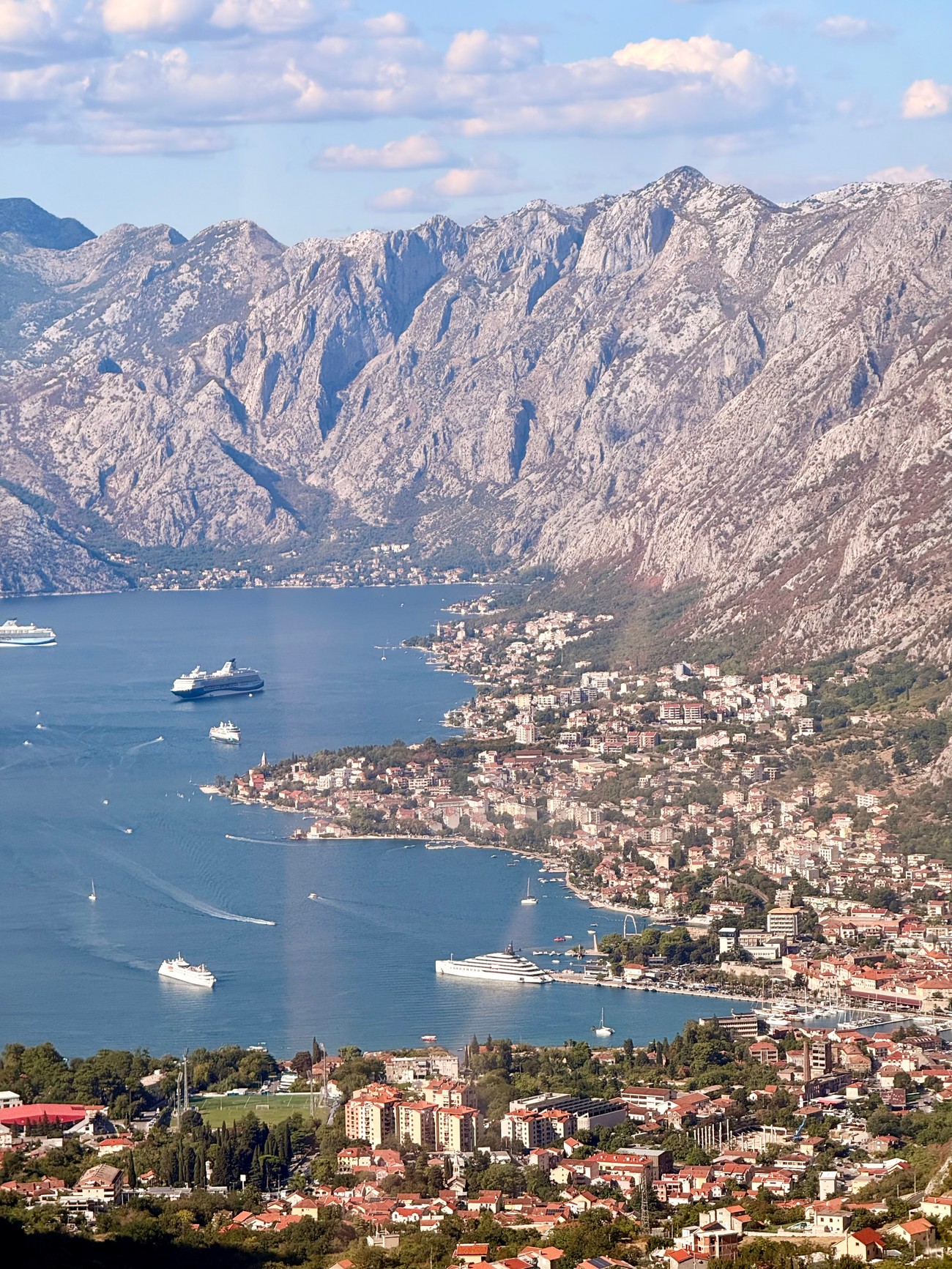
Zoom in once more, to a point near the top of that short Montenegrin coast, and the sea starts doing something unexpected. Instead of running straight, the water turns inland and folds itself into the mountains, squeezing through a channel barely three hundred metres wide into a bay so enclosed and so dramatic that it looks as though it belongs somewhere much further north. That is the Bay of Kotor, roughly two hours by road from Dubrovnik.
I have just returned from there, and I have been trying to describe it to friends ever since, without much success. It is often called the southernmost fjord of Europe, mountains dropping straight into deep blue water, medieval towns wedged onto whatever narrow strip of shoreline the cliffs allow. It genuinely looks like a fjord. There is just one small problem with the description, and it is worth starting there, because it tells you something about how to actually enjoy this trip.
The Bay of Kotor is not a fjord at all. A fjord is carved by a glacier, and no glacier has ever come anywhere near this area. What you are actually looking at is a ria, an ancient river valley that drowned when sea levels rose, leaving behind the same dramatic cliffs and narrow inlets without any of the ice that supposedly makes a fjord a fjord. Geologists have been gently correcting this for years. However, nobody in the tourism industry has any interest in listening, because ‘southernmost ria of Europe’ was never going to sell a single holiday package.
I like this detail because it captures something true about the whole region. Montenegro looks like one thing from a distance, and rewards you with something else entirely once you get close. And that closeness is exactly where most visitors run into trouble, because from the water, or from a cruise ship deck, or from a quick day trip, Kotor, Perast, Sveti Stefan, and Herceg Novi can genuinely start to blur into one continuous postcard. Stone walls, red roofs, turquoise water, repeat. So today, whether you are planning a trip to Montenegro or not, I want to spend this piece taking you on a geographic roller coaster trying to explain how to actually tell these places apart, and enjoy each one for what it specifically is.
Kotor Is the Fortress
Kotor is the anchor of the bay, and the first thing to understand about it is that it is fundamentally a walled, defended city, built to withstand siege after siege across Byzantine, Venetian, and Ottoman centuries. The old town itself is compact enough to walk in twenty minutes, and that compactness is deceptive. The real experience of Kotor is not inside the walls. It is above them.
The city walls climb the mountainside behind the old town in a series of zigzagging fortifications that stretch for over four kilometres and gain roughly two hundred and eighty metres of elevation, up to the Fortress of Saint John. It is a genuinely demanding climb, over a thousand steps in the heat, but it is also the best way to understand why Kotor sits exactly where it does. From the fortress, the entire bay unfolds below you, the narrow Verige Strait, the outer and inner bays, Perast in the distance. Kotor from the water is pretty. Kotor from above the walls is the whole point.
If the climb feels like too much, the newer Kotor Cable Car solves the same problem differently, an eleven minute ride up to Lovcen, the mountain that watches over the entire bay, with the same sweeping view achieved without a single flight of stairs. Either way, treat Kotor as a city you look down on, not just a city you walk through.
Perast Is the Devotion
Perast is a fifteen minute boat ride from Old Town Kotor, and it could not have a more different personality. Where Kotor is defence, Perast is devotion, a town built by wealthy sea captains who spent their fortunes on Baroque palaces along a single waterfront street, and who left behind one of the most moving stories in the entire Adriatic.
In 1452, two fishermen from Perast are said to have found an icon of the Virgin Mary on a small reef just offshore. What happened next took centuries. Every sailor from Perast who returned safely from a voyage began dropping a stone onto that reef, along with old ships deliberately sunk to add to the mass. Stone by stone, voyage by voyage, the reef grew into an entire island, now home to the church of Our Lady of the Rocks, its walls lined with silver votive plaques left by generations of sailors thanking the Madonna for bringing them home. The island is still expanded on the twenty second of July every year, when the town holds a festival called Fasinada and the whole community rows out to add one more stone to a monument that has been under construction for close to six hundred years.
The correct way to experience Perast, then is to take the five minute boat across to that island, stand inside a church built entirely out of gratitude, and understand that you are looking at the slowest, most patient building project on the entire Adriatic coast.
Sveti Stefan Is the Reinvention
Sveti Stefan sits outside the bay, on the open coast near Budva, about an hour by road from Kotor. It tells yet another kind of story, and it is worth knowing before you arrive, because the island itself is now closed to anyone who is not a paying guest of the resort inside its walls.
It began in 1442 as a fortified fishing village, twelve families sheltering behind stone walls against Ottoman raids, and it stayed exactly that, a working fishing community, for five centuries. Then in the 1950s, the Yugoslav government evicted the remaining residents and rebuilt the entire island as a hotel, preserving the old stone houses on the outside while turning them into luxury suites within. It reopened in 1960 and quickly became one of the most famous resorts on earth, drawing Sophia Loren, Elizabeth Taylor, and Princess Margaret, before falling into decline after Yugoslavia broke apart. The Aman Group eventually restored it, and Novak Djokovic married there in 2014, days after winning Wimbledon.
Because the island itself is off limits without a room booking, the correct way to enjoy Sveti Stefan is from a distance, specifically from the hillside viewpoint above it, or from the pink sand beach directly opposite. What you are looking at is not a village anymore. It is the memory of one, rebuilt into something else entirely, and it photographs best as exactly that, a strange, beautiful object seen from just outside its own walls.
Herceg Novi Is the Garden
Herceg Novi takes us back to the very mouth of the bay, where it meets the open Adriatic. It is the town most visitors see last or skip altogether, and that is a mistake, because it is the most livable of the four. Locals call it the City of Sun, and its old town climbs the hillside in such a steep tangle of staircases that the entire settlement is sometimes nicknamed the city of stairs. Because it spans several distinct microclimates across a short vertical stretch, from Mediterranean palm groves near the sea to alpine forest higher up, gardens here grow an almost improbable mix of plants that have no business sharing the same town. The correct way to enjoy Herceg Novi, then, is to slow down completely, wander uphill from the waterfront with no plan at all, and let its stairways, shaded courtyards, and overgrown gardens reveal the town one terrace at a time.
How to Actually See This Bay
Here, then, is the real argument of this piece. This stretch of coast rewards a very specific kind of attention, because every town along it was built for a different reason, and if you rush through all four in a single day, they do start to look the same.
Give Kotor the climb, ideally in the early morning before the heat and the cruise ship crowds arrive together. Give Perast the boat ride to the island, and if your dates allow it, the festival on the twenty second of July. Look at Sveti Stefan rather than trying to enter it, and let it be the strange, reinvented thing it actually is. And save an unhurried afternoon for Herceg Novi, with no fixed itinerary beyond wandering uphill until you get tired of staircases.
Do all four in one rushed day, and you will come home with photographs of stone walls and turquoise water that could have been taken almost anywhere on the Adriatic. Give each town the specific attention it was actually built to deserve, and you come home instead with four completely different stories, a fortress, a devotion, a reinvention, and a garden, all within an hour or so of the same impossibly beautiful ria that everyone insists on calling a fjord. That’s my Montenegro trip for you, see you next week…






 86 videos









Post your Comment
Please let us know your thoughts on this story by leaving a comment.