Published in Indian Express 08th November 2026
Happy Diwali! Today is Sunday, 8th November, Diwali itself, and for most Indian families the question of where to spend it was settled long ago. At home. The cleaning, the rangoli, the lamps at the door, the boxes of sweets arriving from relatives, the first diya lit at dusk for this evening’s Lakshmi Puja, all of it belongs to a particular house in a particular city, and nobody sensible wants to be anywhere else.
I understand that completely, and I am not arguing against it. But there is a quieter fact about this festival that does not get mentioned often enough. Diwali has been travelling for a very long time. Wherever Indians went, as traders, as indentured labourers, as families looking for work, the lamps went with them. Today, besides India, it is an official public holiday in Fiji, Guyana, Malaysia, Mauritius, Myanmar, Nepal, Singapore, Sri Lanka, Suriname, and Trinidad and Tobago, among others. That means there are countries where an entire population pauses for a festival most of us think of as our own.
This piece is about a few of those places, and about a simple argument. Celebrating Diwali abroad is not leaving the festival behind. It is seeing how far it has travelled.
Singapore: A Street That Becomes a Festival
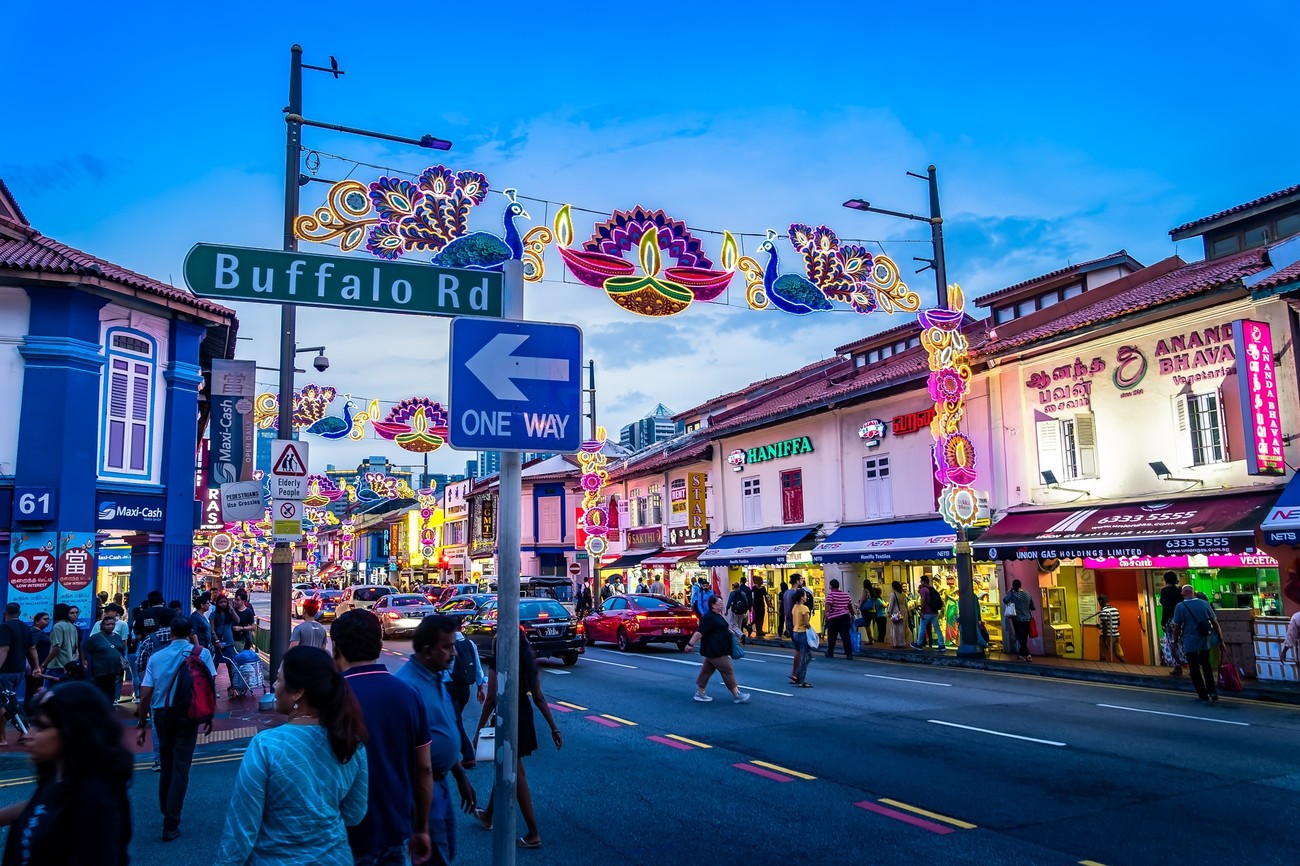
Start with the easiest. Every year, Serangoon Road in Singapore’s Little India is strung with lights for weeks before Deepavali, with illuminated arches overhead. This year, the street light-up was switched on in early October, and the Deepavali Festival Village on Campbell Lane, an evening bazaar of traditional clothing, festive snacks, handicrafts and decorations, has been running since 10th October. It closes tonight, on Deepavali itself. The lights come on at around seven every evening and stay lit until midnight, and the Sri Veeramakaliamman Temple sits on the same road, a few minutes’ walk from the lights.
What makes Singapore a good first Diwali abroad is how gentle it is. It is well connected to Indian cities, the streets are walkable, English is widely spoken, and the festival is staged for everyone who turns up. You can arrive as a complete outsider and still feel that the evening was meant for you.
Nepal: Five Days, and the Dogs Get Garlands
Nepal calls its festival of lights Tihar, and it is quite unlike the one most of us grew up with. It runs for five days, beginning this year on 7th November, and each day honours a different part of life. Crows come first, treated as messengers. Then dogs, who are given garlands, a tika on the forehead, and a proper meal for the day. Unusually, this year Kukur Tihar, the day of the dogs, falls on the same day as Lakshmi Puja, which is today. Tonight, homes across the country will be lit with lamps and decorated with rangoli to welcome Lakshmi. Cows, symbols of prosperity, have their turn too. On 10th November come the oxen and, in the Newar community of the Kathmandu Valley, a ritual of self-worship called Mha Puja. The final day, Bhai Tika, on 11th November, belongs to brothers and sisters, when sisters place a multicoloured tika on their brothers’ foreheads.
Tihar is Nepal’s second-biggest festival after Dashain, and it fills Kathmandu with marigolds, lamps and music. Groups of singers go from house to house performing songs called Deusi and Bhailo, traditionally sung by boys and girls respectively. For an Indian traveller, it is a reminder that a festival you know well can still surprise you in the very next country.
Mauritius: The Island That Lights Every Doorstep
In Mauritius, the festival is called Divali, and it falls today, Sunday, 8th November. The government has also declared tomorrow, Monday, 9th November, a public holiday. Roughly two-thirds of the island’s people are of Indian origin, descended largely from indentured labourers brought over in the nineteenth century, and Hindus make up nearly half the population. Just six days ago, on 2nd November, the country marked its annual public holiday commemorating the arrival of indentured labourers. Tonight, clay lamps will be placed in front of homes, and the island will take on a glow that visitors tend to remember long afterwards.
What stands out is who joins in. Neighbours of other faiths help with the decorations, many families who are not Hindu light a lamp or two of their own, and the holiday belongs to the whole country rather than to a single community. It is a good example of a festival that has outgrown the people who first carried it.
Further Afield
The same story repeats elsewhere. Fiji has a large Indo-Fijian community and marks Diwali with a public holiday, which this year falls on Monday, 9th November. Guyana, Suriname, and Trinidad and Tobago, where the descendants of indentured workers have kept the lamps burning for generations, observe it as a public holiday too. Malaysia observes Deepavali as a public holiday in every state except Sarawak, and Sri Lanka and Myanmar recognise it as well. Each tells the same story from a different shore. People carried something small, a lamp, a recipe, a prayer, and it took root.
The Case for Being a Guest
There is something else worth saying, and it is easy to miss. At home, Diwali is also work. Someone is cleaning, someone is cooking, someone is hosting, someone is keeping track of who has visited and who has not. Someone is up late frying chakli and karanjis. The festival is wonderful, and it is also a long list.
Abroad, the list disappears. You are a guest at a festival that is being kept by other people, and for once you can simply watch the lamps being lit, taste the sweets, and notice details you would normally be too busy to see. A street in Little India after dark, a doorway in Kathmandu with a lamp on every step, a doorstep in Mauritius lined with clay diyas. You see the festival the way a child sees it, as light and food and noise and people, with none of the logistics attached.
None of this replaces the Diwali at home. It simply gives you a second way of looking at it. I suspect that anyone who has watched the festival from the outside comes home with a slightly fuller picture of what it means.
How to Do It Well
If today’s lamps have planted an idea, a few things are worth keeping in mind before you book for next year.
Book early: Diwali week is one of the busiest periods for Indian travel, and flights and rooms tighten as the date approaches. Next year, the festival falls in late October, so it pays to plan well ahead. Arriving a few days early is worth the effort, because the preparation is half the festival. Lights go up, markets fill, and the shopping begins long before the main night.
Confirm the local date: The festival spans several days, and countries and communities mark different ones. Diwali falls today in India, Singapore and Mauritius, but Nepal’s Tihar runs from 7th to 11th November, Singapore and Mauritius add a holiday on Monday, and in Fiji the official holiday falls only on Monday. Check locally before you plan around a single evening.
Go as a guest, not as a spectator: Dress modestly and remove your footwear at temples, ask before photographing a family puja, and accept an invitation if one comes. The people celebrating are not putting on a show. They are keeping a festival alive far from where it began, and they will notice whether you came to watch or to join.
Carry something small: A box of sweets from home travels well and makes a good gift if you are invited into a house. It is a small gesture, but it goes a long way, and it often starts a conversation about how both families celebrate.
A Festival Is Not a Place
For most of us, Diwali will always be a house, a doorstep, a set of familiar faces. That is as it should be. But the festival has proved, over nearly two centuries of migration, that it does not need an address to survive. It needs a lamp and someone willing to light it.
Which is why celebrating Diwali abroad is less of a departure than it sounds. Tonight, as you light the diya at your own door, someone in Port Louis, Kathmandu, Singapore, Suva and Georgetown is lighting one too. The lamp is the same. Only the street is different.
Know the Unknown
Ever since we launched flight bookings on Veena World, I have been falling down rabbit holes about airports. And since this week’s piece includes Mauritius, here is the story of the airport that greets everyone who arrives there for Divali.
The island’s main international gateway is Sir Seewoosagur Ramgoolam International Airport, and until 1987 it was known simply as Plaisance Airport. Its story goes back to 1942, during the Second World War, when Mauritius was a British colony and work began on a military airfield at Plaisance, near Mahébourg. The first aircraft to land there, a Royal Air Force Dakota, touched down on 24th November 1943, and civilian operations began shortly after the war ended.
In 1987, the airport was renamed after the man regarded as the father of the nation. Seewoosagur Ramgoolam was the son of a migrant who had left Bihar for Mauritius as a teenager in 1896. He studied medicine in London and returned to the island as a doctor in 1935. He spent his career working for the island’s labouring majority, largely the descendants of indentured Indian labourers, became Mauritius’s first prime minister, and led the country to independence on 12th March 1968.
So the story of the festival in this piece and the story of the airport turn out to be the same one. The labourers who carried Divali across the ocean in the nineteenth century are the ancestors of a large part of the island’s population today, and the gateway every visitor passes through carries the name of the man who led their descendants into nationhood. The new passenger terminal, inaugurated in 2013, was designed after the traveller’s palm, a tropical plant that grows on the island, which feels like the right image for a country built by people who travelled.
Land there on a Divali evening, and the first thing you pass through is a monument to that journey.
Wherever you are celebrating, the festivities are only just beginning, with Padwa and Bhai Dooj still to come in the days ahead. May the lamps you light tonight bring warmth to your home, and may the week ahead be full of good food, laughter and happy reunions. Wishing you and your family a very happy Diwali.
See you next week…







 90 videos



Post your Comment
Please let us know your thoughts on this story by leaving a comment.