



Published in Indian Express 26th July 2026
I was standing outside a tiny restaurant in Hanoi, trying to figure out what was being served. There was no English menu. No English signboard. Just a woman behind a counter, a pot of something that smelled incredible, and about fifteen locals sitting on plastic stools eating with the kind of focus that told me this was the right place. I walked in, pointed at what the man next to me was eating, held up one finger, and sat down.
What arrived was bun cha, grilled pork patties in a sweet broth with rice noodles and a plate of fresh herbs. It was, without exaggeration, one of the best things I have ever eaten. I didn’t know what it was called until I looked it up later that night. I didn’t know what was in the dipping sauce. I didn’t know that bun cha was a Hanoi specialty and that I had accidentally walked into the kind of neighbourhood place that food writers spend weeks trying to find. None of that would have happened if I had been able to read the menu. I would have studied it, Googled reviews, maybe walked to the next place. Instead, I pointed. And the meal found me.
I have been thinking about this a lot. About what happens when you travel somewhere you don’t speak the language, and how that experience is almost always better than we expect it to be.
The Fear Is the First Thing to Go
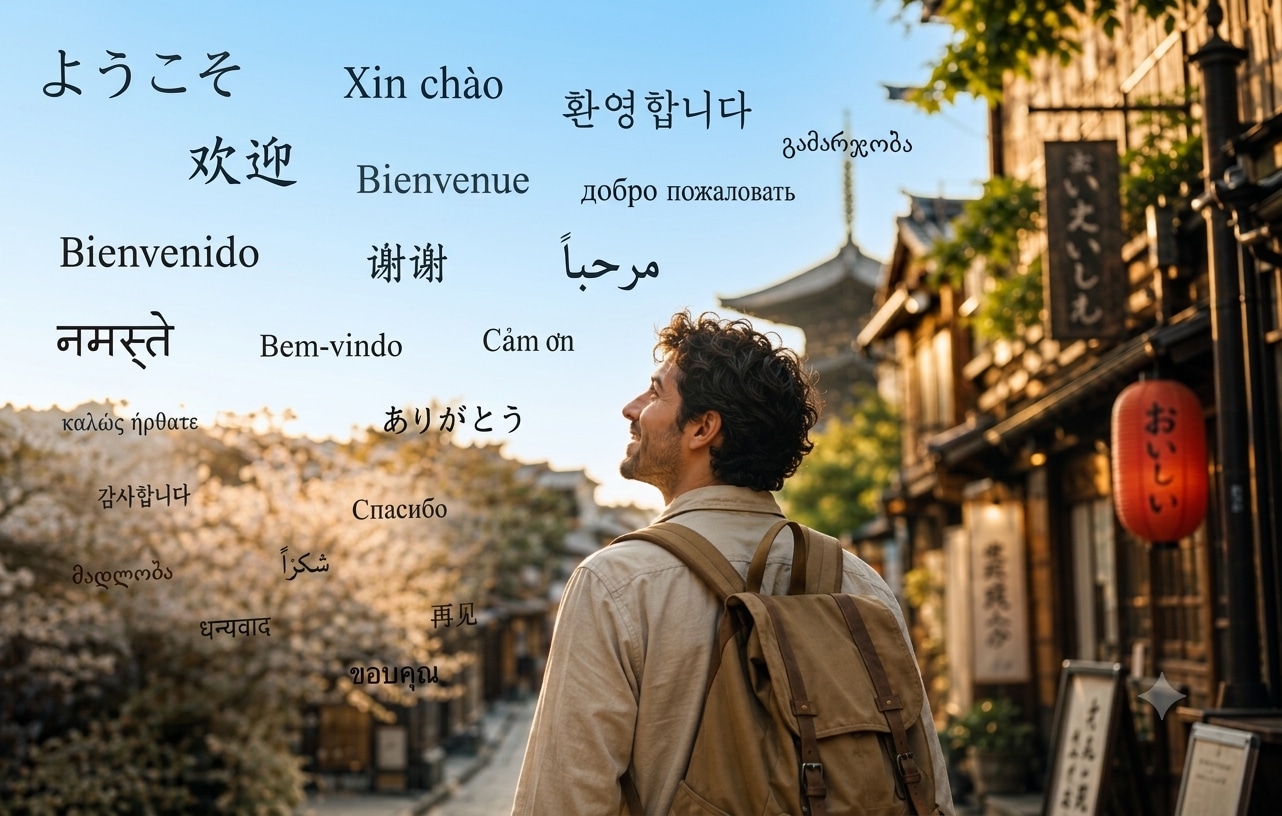
Let’s be honest about what holds Indian travellers back from non-English-speaking destinations. It’s not money. It’s not distance. It’s the language.
I hear it constantly. “I would love to go to Japan, but I don’t speak Japanese.” “Vietnam looks amazing, but how will I manage?” “I want to try South America, but my Spanish is zero.” The assumption is that not speaking the local language makes you helpless. That you will get lost, order the wrong thing, end up on the wrong train, offend someone accidentally, or, the big one, feel stupid.
Here’s what actually happens. You land. You panic slightly at the airport because every sign looks like abstract art. You fumble through your first interaction at immigration. And then, somewhere between the taxi and the hotel, the fear just… leaves. Because it turns out that human beings have been communicating without shared language for about 2,00,000 years, and we are remarkably good at it.
A smile works everywhere. Pointing works everywhere. Holding up fingers for numbers works everywhere. The Google Translate camera, where you point your phone at a menu and it translates in real time, has quietly become the most important travel tool of the decade. And the moment you accept that you won’t understand everything, something loosens in your chest and you start actually seeing the place instead of trying to decode it.
What You Gain When You Lose the Words
The interesting thing about not speaking the language isn’t what you lose. It’s what you gain. When you can’t eavesdrop on the conversation at the next table, you start observing instead. How people greet each other. How they hold their chopsticks. How the waiter interacts with a regular versus a first-timer. In Tokyo, I spent an entire evening at a counter-seat yakitori bar where I understood exactly zero of the conversation around me, and I noticed more about Japanese social dynamics in those two hours than I had in two days of sightseeing. The way the chef bowed slightly differently to each customer. The way nobody raised their voice, ever. The way a regular communicated his entire order with a nod and the chef responded with a nod back, a relationship so established that words had become unnecessary.
You eat better. This sounds counterintuitive, but it’s true. When you can read a menu, you make safe choices. You pick what you recognise. You avoid the things you can’t pronounce. When you can’t read a menu, you surrender. You point at what someone else is having. You let the waiter decide. You say yes to the thing you would normally say no to. Some of my most fun and memorable meals have come from that surrender. A bowl of something unidentifiable in a back lane in Ho Chi Minh City that turned out to be hu tieu (a Southern Vietnamese noodle soup with Chinese-Cambodian origins), a street-side plate in Tbilisi that turned out to be adjarian khachapuri (a famous Georgian cheese bread shaped like a canoe) with a raw egg yolk staring up at me like a dare.
You connect differently. This one surprised me the most. You would think a language barrier would make human connection harder. It doesn’t. It makes it more honest. When you can’t hide behind small talk, you communicate with your face, your hands, your tone. The interactions become simpler but somehow more real. A shopkeeper in Kyoto who spent ten minutes wrapping a small gift for Raya with a level of care that no words could have improved. A cab driver in Kutaisi, Georgia, who didn’t speak a word of English but spent the ride pointing at mountains and saying their names with such pride that I understood exactly what he was telling me. A woman in Hoi An who laughed at my attempt to order in Vietnamese, corrected my pronunciation three times, and then gave me an extra spring roll because, I think, she appreciated the effort.
These interactions don’t happen when everything is smooth and translated and efficient. They happen in the gaps. In the pauses where you are both trying to figure out how to say what you mean without the words for it.
The Myth of the English-Speaking World
There is a comfortable illusion that many travellers carry, which is that English will get you through most places. And sure, in airports, international hotels, and tourist centres, it usually does. But step one lane off the main street in almost any country, and English disappears.
Japan is the most striking example of this. Tokyo is one of the most sophisticated cities on earth, and English proficiency outside the tourist circuits is remarkably low. Train announcements are in Japanese first, English second, and the English often covers only the major stops. Restaurant menus in local neighbourhoods are entirely in Japanese. Even Google Maps behaves differently because addresses work differently. And yet, Japan is also the easiest country I have ever travelled in without speaking the language. Because the infrastructure compensates. The signage is clear even if you can’t read it. The trains are so punctual that you can navigate by timing alone. And the people are so instinctively helpful that someone will walk you to your destination rather than try to explain it.
Georgia was the opposite experience. The infrastructure doesn’t compensate. Signs outside Tbilisi are in Georgian script, which is beautiful but completely impenetrable if you don’t read it. English is limited. Russian helps more, but I don’t speak that either. What Georgia has instead is sheer human warmth. People don’t just give you directions, they drive you there. They don’t just recommend a restaurant, they call ahead and tell the owner you are coming. The language barrier in Georgia isn’t a wall. It’s a door that people on the other side keep opening for you.
Vietnam sits somewhere in between. In the cities, enough English exists to survive. In the countryside, you are on your own. And the countryside is where Vietnam is most itself, rice paddies, water buffalo, families eating lunch on the floor of their front room with the door open to the street. You wave, they wave back, someone gestures for you to sit down, and suddenly you are eating rice with strangers who are laughing at something you will never understand but will never forget.
The Real Reason to Travel Without the Words
I think the deeper truth about travelling where you don’t speak the language is this: it makes you a beginner again.
At home, we are competent. We know how everything works. We read every sign, understand every conversation, navigate every system with the confidence of someone who has been doing it for decades. Travel to an English-speaking country and that competence transfers, you are a tourist, but you are still in control.
Travel to a place where you can’t read, can’t ask, can’t decode, and that competence drops away. You are five years old again. You are looking at the world with the bewilderment and curiosity of someone who doesn’t have the cheat codes. And that feeling, of being genuinely unsure what’s going to happen next, is the feeling most of us are secretly travelling for in the first place. We just don’t admit it because it sounds like a weakness. It’s not. It’s the whole point.
One Last Thing
So the next time someone tells you they would love to visit Japan or Vietnam or Georgia or Turkey or South America but the language puts them off, tell them this: the language barrier isn’t the obstacle. It’s the experience.
The meal you point at blindly. The train you almost miss because you couldn’t read the sign. The conversation conducted entirely in gestures that somehow ends with both of you laughing. The moment you realise you haven’t spoken your own language in six hours and you haven’t missed it.
That's not a limitation. That's travel doing exactly what it's supposed to do, taking you somewhere your competence can't follow, and showing you that you never needed it as much as you thought.
Know the Unknown
You just read an entire article about how the world doesn't share a common language on the ground. But here's the thing: it does in the sky.
Since 2008, every pilot and every air traffic controller on the planet is required to speak English. Not optional. Not recommended. Required. The International Civil Aviation Organization made it mandatory after a series of accidents caused by miscommunication between cockpit and tower. A Korean pilot talking to a French controller in Zurich, a Brazilian crew misunderstanding an instruction in New York. The language barrier that makes travel interesting on the ground was, in the air, really dangerous.
So they fixed it. Today, a pilot taking off from Tokyo speaks to the tower in English. Landing in Sao Paulo, English. Crossing Afghan airspace, English. Every altitude call, every runway clearance, every emergency declaration on earth happens in one language. The sky solved the problem the ground never could.
And here is the small detail that got me: the system uses a stripped-down vocabulary called Aviation English, roughly 300 standardised phrases designed to eliminate ambiguity. “Roger” means received. “Wilco” means will comply. “Say again” instead of “what” because “what” sounds too much like other words at high speed. It is the most efficient common language humans have ever built, and most passengers have no idea it is happening above their heads while they sleep.
Ever since we launched flight bookings on Veena World, I have been going down these rabbit holes. And this one felt like it was made for this week’s article. The ground can’t agree on a single language. The sky already did. See you next week…



 83 videos














Post your Comment
Please let us know your thoughts on this story by leaving a comment.