



Published in Indian Express 02nd August 2026.
I walked out of Christopher Nolan’s Odyssey last week and did something I have never done after a movie before. I opened Google Maps. Not to check directions home as I always would, but rather to look up Voidokilia Beach. Then Favignana. Then Essaouira. Then a black sand promontory in southern Iceland I had never heard of called Hjörleifshöfði. Within twenty minutes of leaving the theatre, I had six tabs open and was pricing flights to places I hadn’t known existed two hours earlier.
That, I think, is the most remarkable thing Nolan has done with this film. Not the IMAX. Not the 91-day shoot. Not Matt Damon on a Viking longship. He’s made a $250 million movie about a 3,000-year-old poem, and the thing it leaves you wanting to do most urgently is travel.
The Rule That Changed Everything
Here’s what sets The Odyssey apart from every other Hollywood epic. Nolan imposed a single rule on himself: no green screens, no digital environments, wherever it could possibly be avoided. If the story needed a beach, they found a beach. If it needed a volcano, they found a volcano. If it needed the underworld, they flew a thousand people to Iceland.
That meant the production travelled to six countries over six months. Morocco, Greece, Italy, Scotland, Iceland, and Malta, hunting down coastlines, castles, caves, and glaciers that could stand in for Homer’s ancient world without a single frame of CGI trickery. Nolan wanted audiences to feel like they were on the boat with Odysseus. And because everything on screen is real, real water, real stone, real light, you do.
The result is that every frame of The Odyssey is, accidentally or not, a travel advertisement. And every location is a place you can actually visit. Let me walk you through the map.
Morocco: Where Troy Burns
The film opens with the fall of Troy, and Nolan built his Troy at Ait Benhaddou, a UNESCO World Heritage Site near Ouarzazate in Morocco. This 11th-century fortified village of red-earth towers has stood in for the ancient world so many times it probably has an agent. Gladiator, Game of Thrones, Lawrence of Arabia, Prince of Persia, they have all filmed here. Nolan added 60 temporary structures, including the pillared Temple of Athena and the city gates, covering 2.5 acres, and brought in 2,000 extras to recreate Troy’s destruction.
Then comes the Trojan Horse sequence, which Nolan had carried in his head for over two decades. He was briefly attached to Wolfgang Petersen’s Troy in the early 2000s before stepping away. He finally realized his version on the beaches of Essaouira, Morocco’s “Windy City” on the Atlantic coast. In Arabic, Essaouira means “little picture.” In IMAX, there’s nothing little about it. The same beach where Nolan buries his Trojan Horse is where Odysseus and his men set out for home, and the shot of the ships leaving the shore with the Moroccan coastline stretching behind them is one of the most beautiful departures I have seen on screen.
Essaouira is about three hours from Marrakech by road. It’s laidback, bohemian, famous for windsurfing and a medina that hasn’t been overrun yet. Ait Benhaddou is roughly two hours southeast of Marrakech. Both are easy additions to any Morocco itinerary.
Greece: Where the Myth Lives
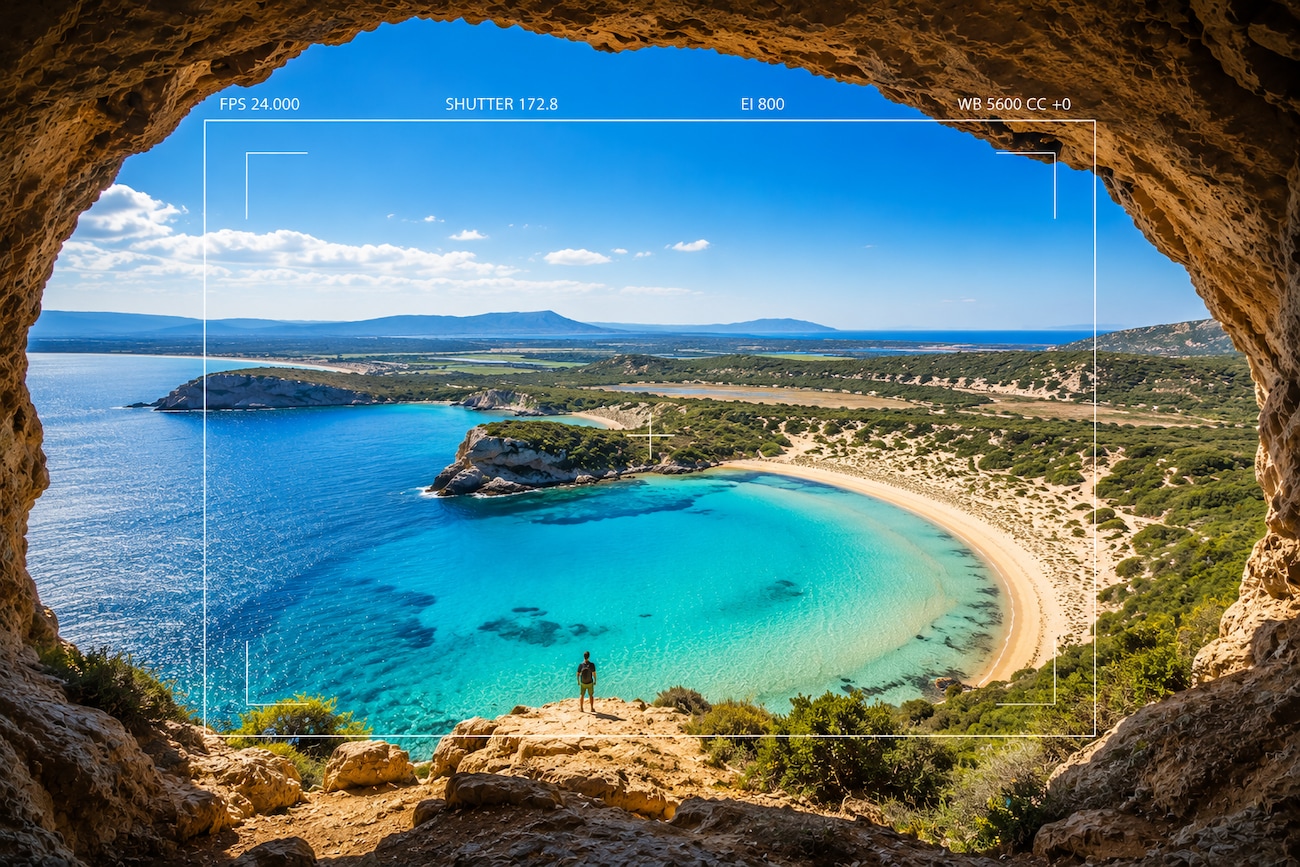
For the Cyclops sequence, Odysseus and his crew stumbling into Polyphemus’ cave, Nolan chose Nestor’s Cave in Messinia, on the southwestern tip of the Peloponnese. The cave sits above Voidokilia Beach, a near-perfect horseshoe of golden sand and turquoise water that looks so symmetrical it seems engineered. It isn’t. It’s just Greece being Greece.
The production also filmed at Methoni Castle, a medieval Venetian fortress that juts into the sea, and at Acrocorinth, the ancient fortified acropolis above Corinth. These are not obscure ruins. They are monumental structures that have been standing for centuries, open to visitors, and somehow still not on most Indian travelers’ radar.
The nearest airport is Kalamata. Fly into Athens and drive the scenic three hours south, or catch a seasonal flight from Europe. May, June, and September are ideal, the light is extraordinary, and the crowds haven’t arrived.
Sicily: Where Odysseus Lives
This is the one that got me. Nolan chose Favignana, a small island off Sicily’s northwest coast, part of the Aegadian archipelago, as Ithaca, Odysseus’ home. Homer himself is believed to have based parts of the poem on this island, calling it “goat island” where Odysseus’ crew landed and barbecued goats.
On Favignana, Nolan used the ruined Castello di Santa Caterina atop Monte Santa Caterina as Odysseus’ palace, where Penelope and Telemachus hold out against the suitors. Nolan has said that when they climbed to the castle and saw the view, it simply felt like Odysseus’ home, even though it was, by his own admission, a deeply impractical location to film.
From mid-April to mid-May, the production moved to the Aeolian Islands, Lipari, Vulcano, and Basiluzzo, for the sequences set on Aeolia, the island of the wind god. Volcanic seascapes, smoking craters, and water so blue it looks artificial. Except it isn’t, because Nolan doesn’t do artificial.
Fly into Palermo or Trapani, catch a ferry to Favignana. For the Aeolians, the ferry runs from Milazzo, about two hours by train from Catania. These are popular Mediterranean summer destinations, but outside July and August, they’re wonderfully uncrowded.
Iceland: Where the Dead Live
For the underworld, Book 11 of the Odyssey, where Odysseus consults the dead, Nolan chose Iceland. Specifically, the black sand plains and coastal rock formations around Hjörleifshöfði, a dramatic promontory on Iceland’s south coast. The filming took 12 days, involved a thousand people including 450 local extras, and was shot in June’s perpetual daylight, which Nolan used to create an eerie, timeless quality.
“I knew early I wanted the landscape of Iceland to portray Hades,” Nolan has said. “This journey north, further and further into the cold, couldn’t be further away from Odysseus’ home in Ithaca.”
He’s right. Watching the sequence, you feel the temperature drop. The black sand, the mist, the volcanic rock, it’s the visual opposite of everything warm and golden that came before. And it’s all real. No filters, no colour grading tricks. Iceland just looks like the underworld.
Scotland: The Quiet Surprise
The least expected location on the list. Nolan filmed on the Moray Firth coast in Aberdeenshire, using the ruins of Findlater Castle and nearby Culbin Forest for northern cliff-and-shore sequences. Scotland’s grey light and rugged coastline gave the film a quality that Mediterranean locations alone couldn’t, a sense of cold, of danger, of being far from home.
What Nolan Proved
Here’s why I think this matters beyond the movie.
There’s a growing school of thought in Hollywood that you can build anything digitally. That locations don’t matter because pixels can replicate anything a camera can capture. And technically, that’s true. The technology exists. You could build Voidokilia Beach in a computer and most audiences wouldn’t know the difference.
But Nolan chose not to. He spent six months and $250 million proving that real places have a quality that pixels don’t. A weight, a texture, an unpredictability that the human eye registers even when the conscious mind doesn’t. When Odysseus’ ship rolls on real Mediterranean waves with real wind filling real sails, you feel it in your body. When the black sand of Iceland stretches to the horizon with real mist rolling across it, something in you responds that no green screen can trigger.
That’s also the argument for travel itself. You can watch a 4K video of Essaouira on YouTube. You can scroll through a hundred photos of Voidokilia Beach on Instagram. But until you stand there, until the wind hits you, until the sand is under your feet, until the light changes in real time, you haven’t experienced it. Nolan knows this. It’s why he sent a thousand people to Iceland instead of building Iceland in a warehouse in a studio.
Real places are irreplaceable. That’s true in filmmaking. It’s true in travel. And The Odyssey is the most expensive, most spectacular proof of that idea anyone has ever produced.
Your Own Odyssey
The beautiful thing about Nolan’s location map is that it’s buildable as a trip. Morocco, Greece, and Sicily are all within a few hours of each other by air. You could do Marrakech to Essaouira to Ait Benhaddou, fly to Kalamata for the Peloponnese coast, ferry to Sicily for Favignana and the Aeolians, and, if you are feeling ambitious, add Iceland as a standalone leg. Two weeks, six countries, and a journey that traces the oldest story ever told across the most beautiful locations on the Mediterranean.
I am already thinking about it. If you have watched the film, I suspect you are too… See you next week…
Know the Unknown
Ever since we launched flight bookings on Veena World, I have been falling down rabbit holes about the places planes take you. And this week, given the article, I couldn’t resist digging into Iceland.
Nolan chose Iceland for the underworld because it felt like another world. Here’s the thing: geologically, it is.
Keflavik International Airport, where every flight to Iceland lands, sits on the Reykjanes Peninsula. The Reykjanes Peninsula sits on the Mid-Atlantic Ridge. The Mid-Atlantic Ridge is the boundary where the North American and Eurasian tectonic plates are slowly pulling apart, at roughly 2.5 centimeters a year. Iceland is the only place on earth where this ridge, which otherwise runs along the floor of the Atlantic Ocean, rises above sea level. Which means when your plane touches down at Keflavik, you are landing on the seam between two continents.
It gets better. Twenty minutes from the airport, there is a small footbridge called the Bridge Between Continents. It spans a fissure in a lava field where the two plates are visibly splitting apart. You can walk from the North American plate to the Eurasian plate in about fifteen steps. One foot in America, one foot in Europe.
Nolan sent Odysseus to Iceland to visit the land of the dead. But the real story beneath his feet was even stranger: a country that is literally being pulled in two directions at once, creating new earth as it goes. Did you know this about Iceland?






 83 videos














Post your Comment
Please let us know your thoughts on this story by leaving a comment.