Published in Indian Express 29th November 2026
Today, I have tried to shift focus to something totally different. And so, here it goes. Until 1964, it was possible to board a train at Madras Egmore station and, with one short ferry crossing and a second train, arrive in Colombo. The service was called the Boat Mail, and it ran along the southern tip of India to a railway station on the edge of the sea. I am heading to Sri Lanka in December, and when I looked into how people once made that journey, I found myself reading about a town that no longer exists. One curiosity led to another, and before long, I had a small list of such places scattered across the country.
That town is Dhanushkodi, and it belongs to a small and strange category of Indian places, where the ruins of an earlier life still have a great deal to say. They are not ruins in the usual sense. Nobody built a fort and lost a war. Each was left behind by something larger than a city, whether the sea, a rumour, the earth itself, or an emperor's change of mind.
The Train That Never Arrived
Dhanushkodi sits at the south-eastern tip of Pamban Island, in Tamil Nadu, about thirty kilometres from Talaimannar in Sri Lanka. Its name means the end of the bow. In the middle of the twentieth century, it was a busy pilgrimage town and a terminus, where the Boat Mail from Madras handed its passengers to a ferry across the Palk Strait. For many travellers of that era, it was the last stop on Indian soil before the crossing.
On the night of 22–23 December 1964, a cyclone of extraordinary strength swept across northern Sri Lanka and the Pamban Island area, driving a devastating storm surge over Dhanushkodi. The sea rolled over the town. A passenger train from Pamban, with more than a hundred people aboard, was only a short distance from the station when the water reached it, and the train was swept away. Estimates of the dead across the region run to about 1,800. The government of Madras declared the town a ghost town, unfit for habitation, and the railway line has not been rebuilt since.
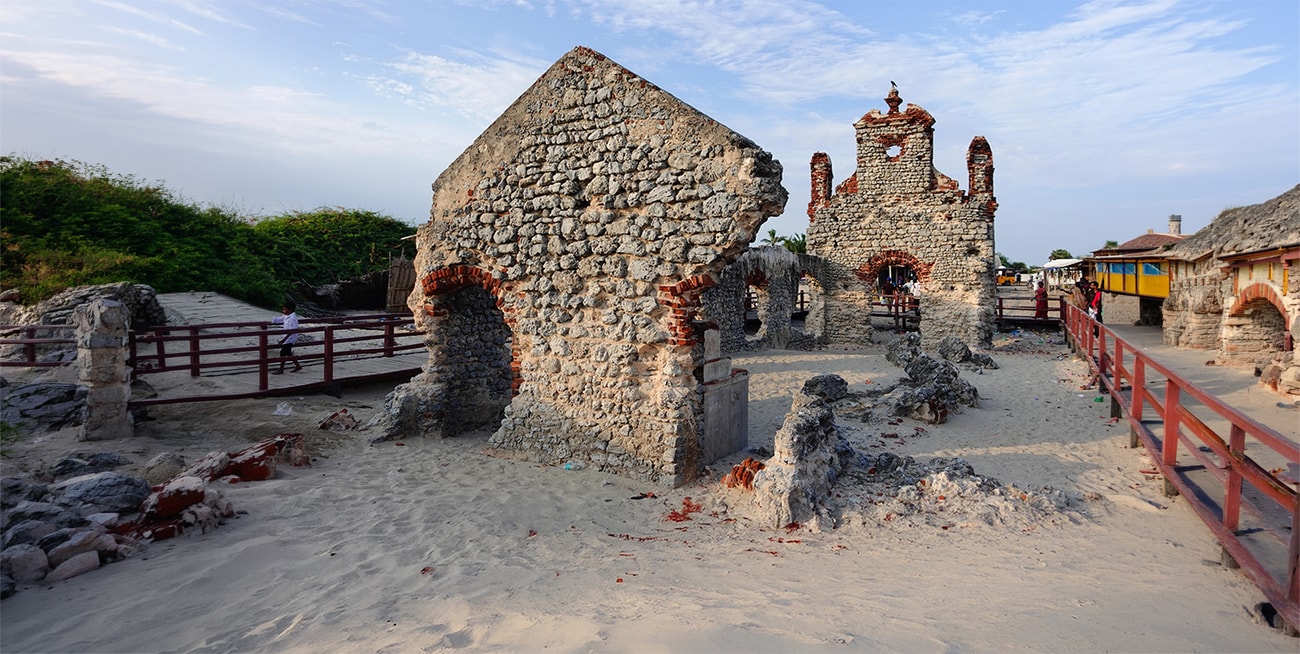
The old town was never rebuilt, but fishing communities continue to live among and around its ruins. A road to the point was completed only in 2017, and visitors now walk among the shells of a church, a railway station, and houses, with the shoals of Ram Setu running out towards Sri Lanka. The wind is constant, and the silence is broken mostly by the waves. It is worth saying that this is a memorial, as much as it is a tourist stop, and the right manner to walk through it is a quiet one.
The Village With Two Stories
On the edge of the Thar desert, about eighteen kilometres from Jaisalmer, lies Kuldhara, one of India’s best-known supposedly haunted villages. It was founded around the thirteenth century by the Paliwal Brahmins, a prosperous community of traders and farmers who were also skilled at conserving water in a land that had very little. Their houses stood along neatly planned lanes, a sign of a settled and confident community. During the nineteenth century, its population dwindled, and the village eventually fell into ruin.
The story told to visitors is a dramatic one. According to the legend, in 1825, Jaisalmer’s powerful minister, Salim Singh, demanded to marry the village headman’s daughter, and rather than submit, the entire community left in a single night, along with the inhabitants of eighty-three neighbouring villages. As they walked away, they cursed the land so that no one would ever live there again. It is a story that has given Kuldhara its reputation.
Historians are less certain. Some point to a failing water supply and heavy taxation, a decline that took years rather than a night. A 2017 study in the journal Current Science argued that damage to buildings suggested an earthquake may have contributed to the abandonment of Kuldhara and neighbouring settlements, though this explanation remains disputed. The legend may contain a kernel of truth, or it may be a story that grew around something quieter and sadder. What nobody disputes is that a community of skilled people left a village they had built, and that the ruins of its lanes and temples are still standing in the sand. The mystery worth visiting is not whether the place is haunted. It is why a whole community could leave.
The Port the River Left
In Kutch, near the border with Pakistan, the walled town of Lakhpat has the opposite problem. It is a fortified town with seven kilometres of stone walls, rebuilt in 1801, and it was once a thriving port at the mouth of the Kori Creek, with the Indus River running near its harbour. Ships, merchants and goods passed through it, and its trade brought considerable wealth to the town.
Then, on 16 June 1819, an earthquake struck the Rann. The earthquake raised a ridge known as Allah Bund, the Dam of God, and dramatically altered the region’s waterways. These changes contributed to Lakhpat’s decline as a port, leaving a small community within walls built for a much busier town. By the 2011 census, only a few hundred people lived inside walls that once enclosed thousands. Walking along those walls today, one can sense both the importance the town once had and the emptiness that followed.
Among the places that remain in use is Gurudwara Lakhpat Sahib. Guru Nanak is believed to have stayed here during his travels, and the shrine’s conservation received an Award of Distinction in the UNESCO Asia-Pacific Heritage Awards in 2004. Inside the same walls, a Sufi tomb and old temples sit among the abandoned houses. In an earlier piece, I wrote about the white desert of the Rann in winter. Lakhpat is the same landscape seen from a different angle, a place where the land itself changed the fate of a city.
The Capital That Was Left
Not every abandoned place was lost to a disaster. Some were left on purpose. In 1571, the Mughal emperor Akbar began to build his capital at Fatehpur Sikri, about thirty-six kilometres from Agra, on a rocky ridge beside the hermitage of the Sufi saint Sheikh Salim Chishti. Akbar had been anxious for an heir, and when his son Salim, the future emperor Jahangir, was born there in 1569, the grateful emperor decided to build a city around the spot.
It was a complete imperial capital in red sandstone, with a great mosque, palaces, courts, and the colossal Buland Darwaza, the Gate of Victory, towering above its monumental flight of steps. It was a city built to last for generations, and every stone of it speaks of confidence. And yet in 1585, only fourteen years after construction began in earnest, Akbar moved his court to Lahore, and by about 1610, the city was almost entirely deserted.
Historians still disagree about why. The most popular explanation is a failing water supply. Others point to Akbar’s military campaigns in the northwest. The imperial complex lost its central role, but later Mughal visits, continued worship, and centuries of conservation helped preserve the remarkable buildings that survive beside the living town today. UNESCO inscribed it as a World Heritage Site in 1986.
What They Have in Common
Four places, and four different stories of change. Dhanushkodi was devastated by the sea, Kuldhara declined for reasons still debated, Lakhpat lost its prosperity as the region’s waterways changed, and Fatehpur Sikri lost its imperial court when Akbar moved to Lahore. None of them was abandoned because its people stopped caring for it. In each case, something larger than the place itself rewrote the map. The people who lived there had little say in what came next.
This is what makes them such strange destinations. A famous monument shows you what a civilisation wanted to be remembered for. A ruin shows you the moment the clock stopped, with the rest of life left lying where it fell.
How to Visit Them Well
These are not theme parks, and a few simple habits make a difference. Go in daylight, since several of these sites close at dusk and the ground can be uneven. Hire a local guide if you can, because the stories are richer and more reliable from someone who knows the place. Do not climb on old walls or take anything away, and treat Dhanushkodi, in particular, as the memorial that it is. And leave the ghost-hunting to others. The truth about these places is more interesting than any ghost story.
I think what draws us to them is something simple. Most travel is about places at the height of their powers, the busiest market, the grandest palace, the tallest tower. A ruin is the opposite. It is a place that has finished, and that is exactly why it feels like it has something to tell us.
Does any other place like this come to your mind? Let me know at [email protected], and let us get the conversation started.
Know the Unknown
Ever since we launched flight and hotel bookings on Veena World, I have been falling down rabbit holes about airports, hotels and the places they leave behind. And the theme of this week’s piece has an aviation version: an entire airport that time left behind.
Nicosia International Airport opened its modern terminal in 1968 and was celebrated at the time as one of the finest in the region, the only international airport of newly independent Cyprus. In July 1974, a coup and a Turkish invasion turned it into a battlefield, and when the ceasefire lines were drawn in August, the airport fell inside the United Nations buffer zone that still divides the island. It has not handled a scheduled passenger flight since.
It stays much as it was left. The cafes, the shops, the offices, the passport booths, and the baggage carousel stand empty. A Cyprus Airways Trident jet, stripped of its engines during the fighting so that another aircraft could escape, sits on the apron where it was abandoned, more than fifty years later. Photographs from inside show dust settled on the counters and signs still pointing passengers towards gates that no longer open. In 1977, three other Cyprus Airways aircraft that had been stranded there were retrieved by British Airways engineers under special UN authorisation and flown to London, which were the last commercial flights out of Nicosia. A new international airport at Larnaca opened in 1975 to take over the island’s traffic.
The old airport’s grounds are now part of the base of the UN peacekeeping force. It is one of the strangest sights in aviation, a full airport kept in a pause, and a reminder that the places we pass through can stop being places we can pass through.
See you next week…











 92 videos









Post your Comment
Please let us know your thoughts on this story by leaving a comment.