Published in Indian Express 27th September 2026
Those moments belong entirely to me, unmediated, unedited, unshared. They exist only in memory, which means they exist only as I experienced them…
There is a scene in ‘The Secret Life of Walter Mitty’ that I came across on Instagram recently. Sean O'Connell, the photographer character played by Sean Penn, has spent months in the Himalayas chasing a single shot of an elusive snow leopard, a creature so rare and so shy that most photographers never see one in their lifetime. And then, finally, it appears. Right there in his viewfinder. The shot he has been waiting for his entire career. He does not take it.
Walter, watching beside him, is baffled. Why not? Why chase something for months and then let it go the moment it arrives? And O'Connell says something legendary in that moment. That when he finds something he loves, he does not like to get distracted by the camera. He just wants to stay in the moment. Let it linger. Right there. Right here.
I was in my twenties when I first watched that scene, and I remember thinking it was a nice piece of writing. A little too neat, maybe. The kind of line that sounds profound in a cinema and slightly performative once you leave. I did not understand it then, but I understand it now, a full 13 years later.
The Years of Trying to Capture Everything
For a long time, I photographed everything. I remember returning from a trip to Japan once, having clicked 12,000 photographs across eight days. Every sunset got a picture. Every meal got a picture, sometimes several, until I found the angle that did it justice. Every mountain, every coastline, every strange and beautiful thing I encountered, I reached for my phone or my camera before I had even finished processing what I was looking at.
I do not think this was vanity, exactly. I think it came from a fear of forgetting. Travel moves fast, and memory is unreliable, and a photograph felt like insurance against the version of yourself ten years from now who cannot quite recall the colour of the sky over Bordeaux or the exact shade of turquoise in a Tasmanian bay. If I did not capture it, I reasoned, I might lose it entirely.
And there is truth in that. I have thousands of photographs that have brought memories rushing back years later, moments I would genuinely have forgotten without the image to jog them loose. Photography, done well, is a gift to your future self.
But somewhere along the way, I noticed something else happening. Certain moments started to feel wrong to photograph. They felt wrong because reaching for the phone would have meant leaving the moment to go and capture it, and something in me understood, instinctively, that the leaving would cost more than the capturing was worth.
The Sunrise in Ladakh
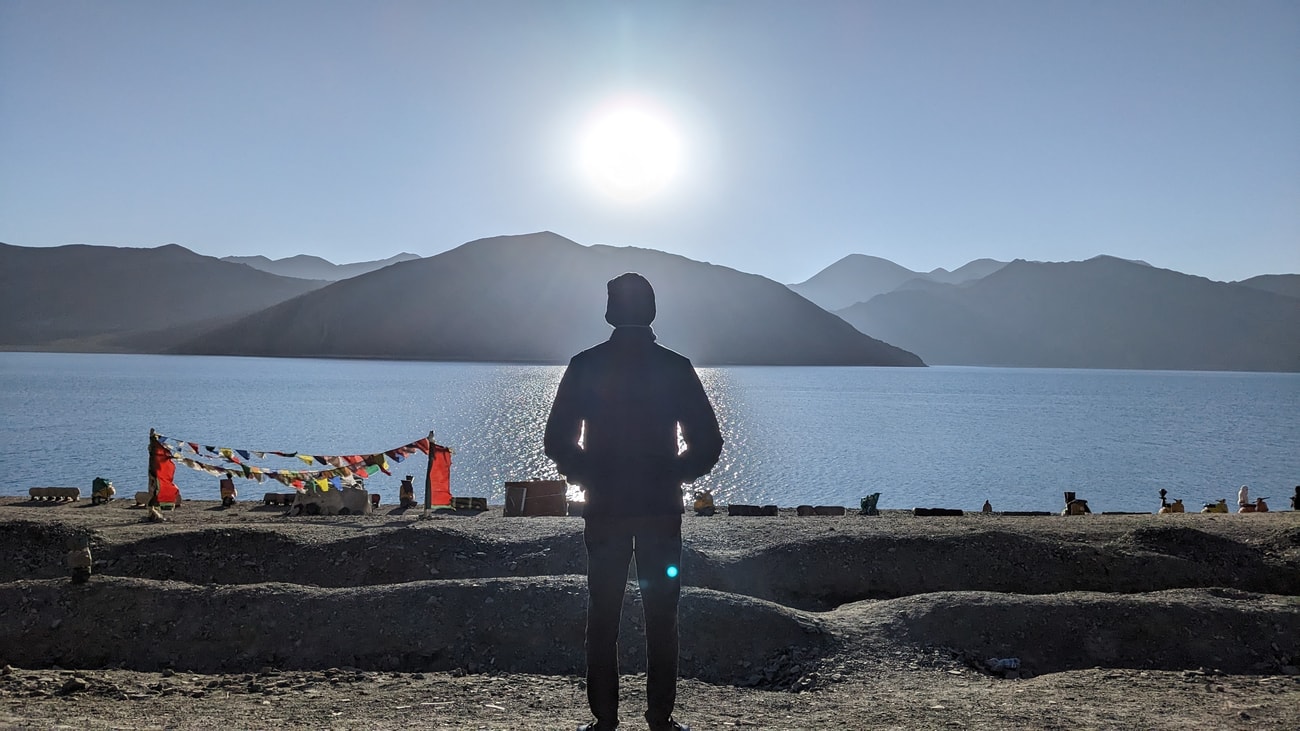
I remember one clearly. We were in Ladakh, up before dawn, driving towards a point where we had been told the sunrise over the mountains was worth the early start. We got there in the dark, the cold biting through every layer we had on, and we waited.
And then the light started to change. Slowly, the way it does at altitude, where the sky seems to consider its options before committing to colour. The peaks went from black to grey to a deep blue-violet, and then the first orange line appeared along the ridge, and within minutes the entire range was lit gold. My younger self would have immediately reached for that phone in my pocket, but this time I did not take it out.
I do not fully know why, even now. Some part of me understood that the moment I looked at that sunrise through a four-inch screen instead of my own eyes, I would be watching a slightly worse, slightly smaller version of what was actually happening in front of me. And that once I started composing the shot, adjusting the exposure, deciding whether to include the foreground rocks or crop them out, I would no longer be a person watching a sunrise. I would be a person doing a small piece of work, with a sunrise as the raw material.
Years later, I do not have a single photograph of that sunrise. And it remains one of the most vivid memories I have of that entire trip. More vivid, if I am honest, than moments I photographed extensively and now barely remember beyond the images themselves.
The Conversation in Hoi An
The second one is different. And this one is about a person.
We were in Hoi An, and I had struck up a conversation with an elderly woman running a small noodle stall. With language as a barrier, this was the kind of conversation that happens entirely through gesture and goodwill. She had corrected my attempt at ordering in Vietnamese three times, laughing harder each time, and by the end she was sitting across from me, showing me photographs of her grandchildren on an old phone, and I was showing her photographs of my travels through the country.
There was a moment, near the end of that exchange, where I genuinely considered asking if I could take a photograph of her and her food stall. And I did not. Something about asking felt like it would turn a real, spontaneous human exchange into a piece of content. Into proof. Into something for later rather than something for now. I wanted, for once, to let an interaction with a stranger exist only in the space where it happened, without needing to survive as evidence.
I think about that conversation sometimes. I do not have a photograph. I have the memory of her stall, that conversation, and that feels, strangely, like more than a photograph would have given me.
What O'Connell Understood
I think what that scene in Walter Mitty is really about is not photography at all. It is about the difference between experiencing something and collecting it.
A camera, even a brilliant one, does something specific to your attention. It asks you to step slightly outside the moment in order to frame it. You become, for a few seconds, an observer of the thing rather than a participant in it. Most of the time, this trade-off is worth it. You get a photograph, and the cost to your presence is small. A quick photo of a meal, a landmark, a family group shot, none of that meaningfully pulls you out of the experience.
But some moments are too fragile for that trade. The sunrise that is changing every thirty seconds. The conversation that only works because both people are fully present. The silence in a monastery, the first sight of a mountain range, the specific quality of light at a specific second that will never happen in exactly that way again. For these, the act of reaching for a camera does not just interrupt the moment, it changes what the moment is. You stop being someone the sunrise is happening to. You become someone documenting a sunrise happening to someone else, and that someone else used to be you.
O'Connell had spent months waiting for the snow leopard. He understood something that took me years of travel to learn: sometimes the whole point of chasing something extraordinary is to be fully present for it when it arrives, not to walk away with a record of it. The photograph and the moment are not the same thing, and sometimes you genuinely have to choose.
What I Have Stopped Doing
These days, I still photograph plenty. My travels with Heta and our two kids. The obligatory landmark photos, because they are fun and they are easy and there is no real cost to taking them.
But I have stopped photographing everything. I have learned to recognise the moments that ask to be left alone, the ones where I can feel, almost physically, that reaching for a phone would be a kind of betrayal of what is actually happening. A particular silence. A particular light. A conversation that only works if both people stay in it completely.
I do not have photographs of some of the best moments of my travelling life. I used to think that was a loss. I have come to think it is the opposite. Those moments belong entirely to me, unmediated, unedited, unshared. They exist only in memory, which means they exist only as I experienced them, not as I later chose to frame them.
Sean O'Connell let the snow leopard go and kept the moment. I think, more and more, that is the better trade.
Know the Unknown
Ever since we launched flight bookings on Veena World, I have been falling down rabbit holes about what is happening on the other side of that window seat. This week, thinking back to that sunrise in Ladakh, I found something that changes how I look at the sky whenever two planes cross in the same frame.
The next time you are looking out a window and another aircraft passes in the opposite direction, look closely. Chances are the two of you are not sharing an altitude, even though your eye cannot tell the difference from a distance.
There is a rule that governs almost every commercial flight in the sky, and most passengers go their entire lives without knowing it exists. Pilots have a mnemonic for it: East is Odd, West is Even. Any aircraft heading broadly east, anywhere from due north round through east to due south, cruises at an odd flight level, say 33,000 feet or 35,000 feet. Any aircraft heading broadly west, from due south round through west back to due north, cruises at an even flight level, say 32,000 feet or 34,000 feet. The two are kept at least a thousand feet apart, sometimes two thousand, depending on where in the world you are flying.
It sounds like a small technicality, but it is one of the reasons a corridor as busy as Mumbai to Delhi does not turn into chaos. Hundreds of aircraft crossing in opposite directions, every single day, sorted invisibly by the direction they happen to be pointed. No controller is nudging each aircraft into place in real time. The direction of travel decides the altitude, decided before the aircraft has even pushed back from the gate.
I find something oddly moving about this, in the same way I found something moving about that sunrise. There is an entire order sitting directly above us, silent and exact, doing its work without ever asking to be noticed. We fly through it constantly, we watch two aircraft pass each other from our window seats, and we assume it happened by luck. It happened because of a rule almost none of us will ever learn, holding two aircraft a thousand feet apart while we finish an in-flight meal without a second thought.
See you next week…







 90 videos




Post your Comment
Please let us know your thoughts on this story by leaving a comment.