



Published in Indian Express. Date 21st June, 2026
I want to tell you about a rabbit hole I went down last week.
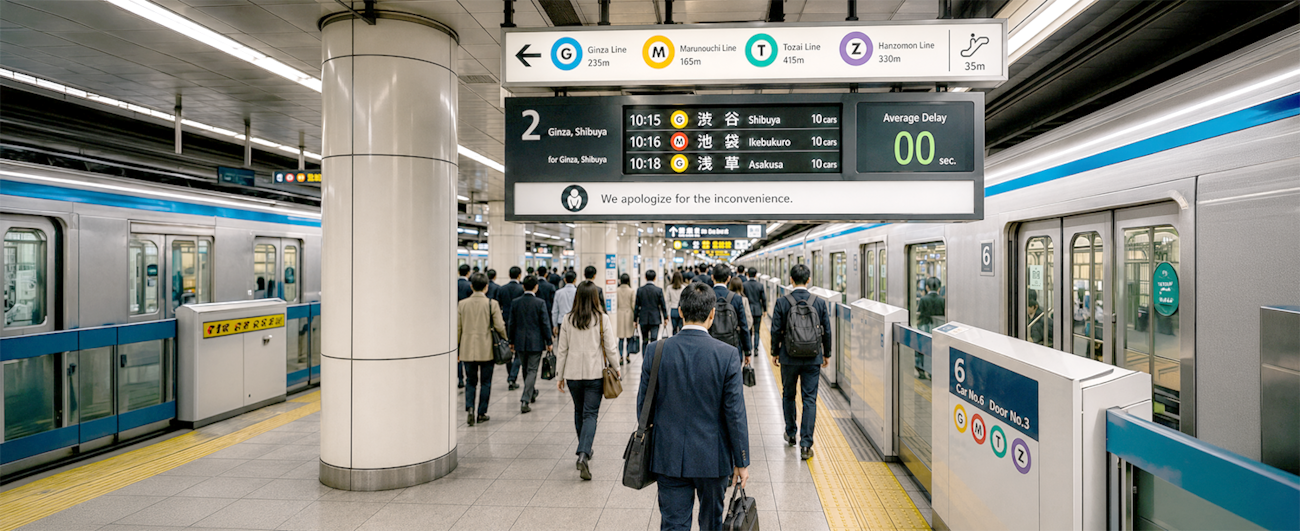
It started innocently enough. I had been to Tokyo eight times. Eight. And yet, on a quiet weekday evening, I found myself watching a YouTube video explaining the Tokyo metro system, a map that has confused, intimidated, and defeated travellers for decades. I wasn't planning a trip. I was just curious. The map isn't complicated. It's actually one of the most logical transit systems ever built. Every line has a colour, a letter, and a number. So if you are on, say, the Ginza line (orange, letter G) and you need to get to G-07, you just watch the numbers count down. You don't need to read Japanese. You don't need to memorise station names. You just follow the number. In a city of 14 million people moving in every direction simultaneously, someone sat down and made it simple for a stranger.
I want you to put a pin in that thought for a minute. Because when we travel, we are all strangers to a city. And if someone has sat down and put in the effort to make that city a little more intelligible for us, that means something significant. For today, I decided to think about cities I have been to: Tokyo, Barcelona, New York, Melbourne, Rome. When I think about these cities, what strikes me isn't the landmarks or the famous streets. It's the intelligence underneath each of them, the quiet, deliberate, often invisible thinking that makes these cities work. Every great city has a system. And almost none of them are obvious. You have to be curious enough to look. So let's start with the city that started this whole rabbit hole.
Tokyo: Logical Intelligence: I often tell people that Tokyo is one of the most modern cities in the world. But more than that, it is one of those rare places where the system just works. The trains run on time, and I don't mean "mostly on time" the way we use that phrase loosely. The average delay across the entire Tokyo metro network is measured in seconds, not minutes. If a train is cancelled, the railway issues a formal apology. That is the standard they hold themselves to.
The Tokyo metro serves around 8 million passengers every single day. And yet, if you understand three things, colour, letter, and number, you can navigate the entire city without speaking a word of Japanese. The system removes every possible point of confusion for someone who doesn't know the city. And here's the interesting part: this wasn't designed for locals. Locals know the station names, know the routes, know the exits. This was designed for the stranger, for the first-time visitor who can't read the signage and doesn't know the pronunciation. Someone, somewhere, thought about that person specifically and built a system around them. That's not just good design. That's empathy, expressed through infrastructure. After eight visits, Tokyo still surprises me. But now when I stand on a platform and watch those numbers tick by, I see a city that decided, a long time ago, that a stranger's morning should be as smooth as a resident's.
Barcelona: Visual Intelligence: Last year, I visited Barcelona with my wife Heta and our daughter Raya. Getting around felt easy, surprisingly easy. For a city I had never spent real time in before, I almost always knew where I was. Barcelona's navigability isn't an accident. It is the result of one man's vision, executed in 1859, that the city is still living inside today.
His name was Ildefons Cerdà. He was an urban planner and engineer, and when the city of Barcelona decided to expand beyond its cramped medieval walls, Cerdà was handed the job of designing the new district: the Eixample, which simply means "the expansion." What he drew became one of the most influential urban plans in history. Cerdà designed a perfect grid, but he did one thing that makes Barcelona instantly recognisable from the air. He cut every corner of every block at 45 degrees. These chamfered corners weren't decorative; they were deliberate. They made it easier for carriages to turn. They created small open spaces at every intersection, allowing light, airflow, and room to breathe. Multiply that across hundreds of blocks and you get a city that feels open and legible at street level in a way that most cities simply don't.
Look at an aerial photograph of Barcelona and you will see it immediately: that distinctive octagonal grid stretching in every direction, perfectly uniform. No other major city in the world looks quite like it from above. But here's what I find most remarkable. Cerdà originally designed the interior of each block to have a garden, the idea being that no resident should live too far from green space. The city eventually overrode him, but the bones of his thinking are still there.
One more thing. If you have seen photographs of that impossibly intricate, still-unfinished cathedral in Barcelona, the Sagrada Família, or the wavy, mosaic-covered building on Passeig de Gràcia, you have seen the work of Antoni Gaudí. He did all of his most extraordinary work inside Cerdà's grid. The order that Cerdà created gave Gaudí the canvas to be beautifully chaotic. You cannot fully appreciate one without the other. Walking those streets with Heta and Raya, I didn't know any of this. I just knew the city felt good to be in. Now I know why.
New York: Grid Intelligence: Manhattan should be overwhelming. It is loud, dense, vertical, and relentless. And yet, most first-time visitors find their footing surprisingly quickly. In 1811, three city commissioners sat down and drew a grid over Manhattan, most of which didn't even exist as a city yet: twelve avenues running north-south, one hundred and fifty-five streets running east-west, with numbers increasing predictably in one direction. It was an audacious act of planning for a future the city hadn't grown into yet. Critics called it soulless. What it actually was, was legible. A stranger arriving in Manhattan today navigates by the same logic someone would have used two hundred years ago.
But the grid alone isn't what makes New York interesting. It's the exception to the grid: Broadway. That diagonal slash cutting across the entire island predates the grid entirely. It follows an old Lenape trail, a path indigenous people walked long before any city existed here. The commissioners couldn't erase it, so they kept it. And every place where Broadway crosses the grid, something remarkable happens. Times Square. The Flatiron Building. Columbus Circle. The city's most iconic intersections exist precisely because an ancient trail refused to conform to a modern plan. The rule created order. The exception created character. New York, perhaps more than any city, is the product of both.
Melbourne: Human Intelligence: I spent four years of my life in Melbourne, and every time I go back (which I do fairly regularly) I get the same feeling within about twenty minutes of being in the city: this place was planned for people. It's hard to put your finger on it at first. But spend a few days there and it becomes clear. The tram network covers the city like a grid, free in the central zone and reliable everywhere else. The laneways, narrow and easily missable, are full of coffee shops, restaurants, and street art that you would never find if you weren't on foot and curious. The city actively rewards the pedestrian.
Australia, I think, does this particularly well. There is a culture of civic planning there that takes seriously the question of what daily life should actually feel like, not just how to move people from point A to point B, but what happens in between. Melbourne's answer is built into its streets. The 20-minute neighbourhood philosophy, the idea that everything you need for daily life should be within a 20-minute walk or bike ride, isn't just a policy. You feel it: parks, schools, cafes, markets, and public transport, all woven together deliberately. It is a city that genuinely seems to like its residents. And that, when you experience it, is a rare thing.
Rome: Temporal Intelligence: Most cities build on empty land. Rome builds on top of itself. Walk through it and you are rarely walking on just one city. Beneath the street you are standing on is a medieval town. Beneath that, a Roman republic. Beneath that, traces of a civilisation that was already ancient when Julius Caesar was alive. Rome has been continuously inhabited for nearly three thousand years, and almost none of it has been erased. It has simply been built over, layer by layer, each era leaving something behind.
The Pantheon is perhaps the clearest example. It has been standing, largely intact, for nearly two thousand years. It was a Roman temple, then a Christian church, and today it is one of the most visited buildings on earth, still used, still functioning, still with its original unreinforced concrete dome that no one has ever fully explained how they built without modern engineering. Walk ten minutes in any direction in Rome and you will find a piazza, and every piazza has a reason it exists exactly where it does: an old market, a church built on a pagan site, a fountain marking where an ancient aqueduct once ended. Nothing in Rome is arbitrary. The city looks chaotic on the surface (the traffic alone is enough to convince you of that), but underneath, every corner has a story that goes back further than most countries have existed. Rome rewards the traveller who slows down, looks carefully, and asks why something is where it is.
The Turn: We have been trained to see cities: landmarks, monuments, bucket-list squares, and famous streets. We arrive with a checklist and we leave having photographed most of it. And there is nothing wrong with that; those places are famous for a reason. But there is another way to travel. It starts with a different question. Not: what should I see in this city? But: how does this city think? What problem was it solving when it was built? What do its streets tell you about its values? Who did the people who designed it have in mind? Every city has this layer. Most travellers never find it, because they never thought to look.
And that brings me back to where this all started: a quiet weekday evening, a YouTube video, a train map that looked impossible, and the realisation that somewhere in Tokyo, a long time ago, someone sat down and thought carefully about a stranger's morning. That's not engineering. That's empathy. So the next time you arrive somewhere new, before you open the map and head to the first landmark, take a moment. Look at the street you are standing on. Ask why it's there. The city will start talking to you in a language that has nothing to do with words. That, I think, is when travel gets really interesting. See you next week!






 83 videos











Post your Comment
Please let us know your thoughts on this story by leaving a comment.