



Published in Indian Express. Date 31st May, 2026
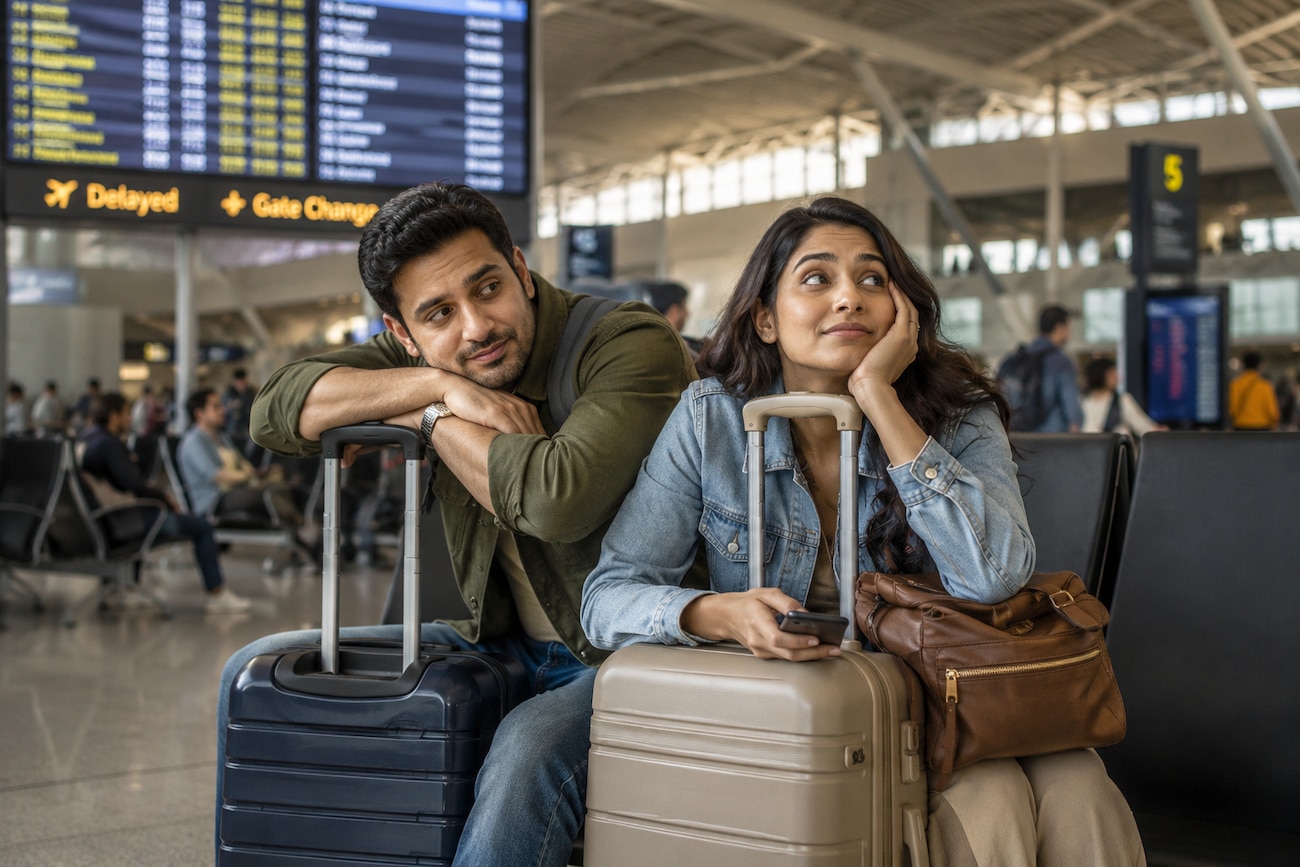
I want to start with a question. Think about your last holiday, not the photos you posted, not the highlights reel you narrated to friends and family when you got back. Think about the other parts. The small, frustrating, sometimes absurd moments that filled the gap between arriving and actually enjoying yourself. Sound familiar?
Here is what I have come to realise after years of travelling, both personally and professionally: the gap between a holiday in our imagination and a holiday in reality is almost always filled with frustrating moments. Not the kind that ruin everything, not disaster-level chaos, but a steady drip of small, avoidable, sometimes hilarious things that erode the first day or two of a trip before the holiday finally finds its rhythm.
I wrote an article some time ago about flying frustrations, the four phases of a flight experience and how to navigate each one without losing your mind. The response was remarkable, because almost everyone, regardless of whether they fly once a year or once a month, had a story. A missed gate. A destroyed suitcase. A middle seat on a fourteen-hour flight next to someone who immediately wanted to have a conversation. And the thing is, more often than not, these frustrations don’t stop at the airport. They continue, right into the holiday itself.
So today, I want to talk about this, the holiday frustrations that we don’t discuss enough, because we’re too busy curating the good parts, and what I have personally learned to do about them.
The Planning Trap
It starts before you even leave home. In fact, it starts the moment you decide to go somewhere. Planning a holiday today means dealing with information overload: multiple booking platforms showing different prices for the same hotel, reviews that contradict each other, and recommendations from friends who visited years ago and whose favourite restaurant has since shut down. I have, as part of my job, spent entire evenings researching a destination, bookmarked a dozen hotels, and closed my laptop having booked nothing, paralysed by two options that were essentially identical.
The advice problem is real. You mention you are going somewhere and within a day your phone is full of WhatsApp messages from people recommending places, half of which are outdated or based on a completely different kind of trip. I now ask for recommendations from one or two people whose travel sensibility I actually trust and who have been there recently. That’s it.
The other trap is over-scheduling. When you have spent a significant amount on flights and accommodation, there is a natural urge to fill every hour and see everything. What actually happens is that you exhaust yourself by Day Two trying to execute a plan that was never realistic. Some of the best moments on any trip come from having no plan at all, and that requires deliberately leaving space for it.
The Hotel Surprise
Hotel photos are optimistic at best. The wide-angle lens, the carefully chosen lighting, the one corner of the room that photographs well. I have checked into rooms that looked spacious and bright in the listing and turned out to be neither. ‘Sea views’ that require you to lean out the window at a specific angle. ‘City views’ that face a car park. Heta has become very good at identifying the tell-tale signs in hotel photos before we book, and she is almost always right about what we will actually find.
The check-in time problem is one that doesn’t get talked about enough. You land at 9am, check-in is at 2pm, and you now have several hours in a new city with your luggage and nowhere to leave it. I now either book the previous night’s room if I know I am arriving early, or I email the hotel in advance to ask about early check-in. It works more often than most people expect, and the alternative, dragging bags around all morning, is simply not worth it.
There is a third thing worth mentioning: the negative review you chose to ignore. Every hotel listing has at least one review mentioning noise, ongoing construction, or thin walls, and almost every traveller has at some point decided it probably won’t be an issue, and then spent a night discovering that it very much is. I read those reviews carefully now and take them seriously. If multiple people mention the same problem, it is a problem.
The Sightseeing Ambush
This is where holidays get properly humbling. You have done the research, you know what you want to see, and you have a rough order in mind. Day One: the famous old town. Day Two: the museum everyone talks about. Day Three: the viewpoint at sunset. You feel prepared. And then the destination politely dismantles your plan. The museum is closed on Tuesdays. It is Tuesday.
The landmark under renovation. The attraction closed for a local holiday you didn’t know about. The viewpoint accessible only by a trail that, per a sign at the trailhead, is currently closed for maintenance. The old town market that runs only on weekends, and you are there on a Thursday. None of these things are disasters. All of them are entirely avoidable, and yet almost all of us fall prey to at least one of them at some point during a holiday.
And then there is the queue problem. The world’s most visited attractions are popular for good reason. They are genuinely extraordinary. But between you and the extraordinary thing is often a line of fellow human beings stretching far enough to make you question your life choices. I have stood in queues at the Vatican, at the Eiffel Tower, at various temples and palaces and natural wonders, watching the minutes tick by, calculating whether I will make it in before closing time. Timed entry tickets, booked in advance, have transformed my sightseeing life. Not every attraction offers them, but for the major ones, the Colosseum in Rome, the Uffizi in Florence, Machu Picchu, the Louvre, they are almost always available, often for the same price as a walk-in ticket, and the difference in experience is enormous. You walk in. Other people are still in the queue. You feel, briefly, like you have figured something out.
The other sightseeing reality that guidebooks somehow never fully prepare you for is distances. Google Maps will tell you that two attractions are a twelve-minute walk apart. What it will not tell you is that the walk is uphill, on uneven cobblestones, in the full afternoon sun, and that you are wearing shoes that were entirely reasonable this morning and are now your enemies. I now wear comfortable shoes every single day of a holiday, without exception, regardless of what we are doing in the evening. It is a small decision that has had an outsized impact on my enjoyment of every trip since I made it.
The Food Gamble
This one is deeply personal to me, because I care about food probably more than I should. When I travel, eating well is not optional. It is, for me, one of the primary reasons to go somewhere. The food of a place tells you something about its history, its geography, its culture, and its people that no museum can match. A bowl of pho in Hanoi, a plate of fresh seafood in a coastal town in Spain, a wood-fired pizza in Naples. These are experiences I look forward to for weeks in advance and remember for years afterwards.
Which makes the bad food experiences sting a little more than they probably should. Here is a situation I have been in more times than I would like: you have done your research, you have a list of restaurants you want to try, and you arrive at the first one to find a ninety-minute wait with no reservations accepted. Fair enough. You didn’t book. You move to the second option. Also full. By this point it is 9pm, you are tired, and you end up at a place nearby that looked acceptable from the outside. The food is fine. Not bad. Just fine. And you sit there eating fine food, knowing that somewhere in this city there is a perfect meal happening without you.
I pre-book at least one restaurant per day now. Not every meal. I like the spontaneity of wandering and finding something that looks good. But one meal per day, the one I am most looking forward to, gets a reservation. It is a small habit that has removed more frustration than almost anything else on this list.
The other food frustration worth naming honestly is the vegetarian problem. Heta is a vegetarian, and while the world has made enormous progress on this front, major cities everywhere now have excellent vegetarian options, there are still destinations, restaurants, and airlines where being vegetarian is treated as an unusual preference that nobody quite planned for. I have had the experience of being handed a menu and finding that the vegetarian section consists of french fries and a salad. I have pre-ordered vegetarian meals on long flights for Heta only to be told, somewhere over the middle of an ocean, that they have run out. I now always confirm our meal selections before boarding, and when travelling to destinations where vegetarian food requires more effort to find, I do that research seriously before we arrive, not optimistically on my phone at lunchtime when we are already hungry.
The Group Dynamic
Travelling with family or a group of friends has its own category of frustrations that have nothing to do with the destination. Someone wants to sleep in; someone wants to leave at 8am. Someone wants to shop; someone wants to sightsee. No one is ever hungry at the same time. The lunch decision alone can consume forty-five minutes of a perfectly good travel day.
The one thing I have found that genuinely helps is building deliberate free time into the itinerary. A few hours each day, or at least one half-day, where everyone splits up and does their own thing. You reconvene for dinner with stories to tell and without the accumulated friction of trying to keep everyone happy all day. It sounds obvious, but most group trips never do this, and that is usually where the tension comes from.
And Yet, It’s Always Worth It
Despite everything I have described, the trips I remember most vividly are rarely the ones that went smoothly. They are the ones where something went sideways and we adapted. The restaurant that was full, so we ended up at a street stall that turned out to serve the best meal of the trip. The closed viewpoint that sent us down a different path entirely. The over-scheduled day that collapsed, and we spent the afternoon just sitting somewhere doing nothing, which, honestly, was exactly what we needed.
Frustrations are part of travel. Checklists help reduce them, but they won’t eliminate them. What they do is protect the parts of the holiday that matter most, so that when something unexpected does happen, you have the energy and the good humour to deal with it.
So, how many of these did you recognise from your last trip? And what have I missed? I would love to hear your frustrations and, more importantly, what you have learned to do about them. See you next week.



 83 videos









Post your Comment
Please let us know your thoughts on this story by leaving a comment.