



Published in Indian Express 5th July 2026
We launched the Trans-Siberian Explorer tour a few weeks ago, and for the better part of two months before that, along with the team, I was buried in maps of a part of the world most Indian travellers never really think about. Mongolia, Siberia, the Russian Far East, the old Soviet rail network that cuts across eight time zones.
It is the kind of research that pulls you sideways constantly, because every region up there borders three others you didn’t plan to look at. That is how Uzbekistan kept showing up. It isn’t on the Trans-Siberian route. It has nothing to do with the railway, technically. But it kept appearing in every adjacent search, every old Silk Road map, every conversation about Central Asia I had while building the route for something else entirely.
After the fourth or fifth time, I stopped treating it as a distraction and started actually looking at it properly. Uzbekistan barely registers on the Indian traveller’s map right now. It isn’t in the Goa-Bali-Thailand conversation, it isn’t in the Europe conversation, it isn’t even really in the “offbeat” conversation the way Georgia or Armenia have started to be.
And this is the very gap that I want to talk about today. There is a version of Central Asia sitting right there, two and a half hours by direct flight from parts of India, that most of us have simply never been told to look at.
What Changed
Until a few years ago, Uzbekistan was genuinely difficult to visit. Visas were a process, the tourist infrastructure was thin, and getting there meant a clumsy connection through somewhere else. Today, Indians still need a visa. The difference is that it's now an e-visa, not a trip to an embassy.
You apply online, upload a scan of your passport, pay the fee, and the approval usually comes back in two to three working days. That's a meaningful change from a process that used to involve actual paperwork and patience. Flights have caught up too.
Delhi and Mumbai both have direct flights to Tashkent, a little over two and a half hours in the air, which is shorter than flying to most of Europe. IndiGo, Air India, and Uzbekistan Airways all fly the route. And just a few months ago, Air India struck a codeshare with Uzbekistan Airways covering Delhi, Mumbai, and a seasonal Goa service, with through-checked baggage and onward connections to Samarkand, Bukhara, and Khiva built into a single ticket.
That's the kind of connectivity upgrade that usually shows up after a destination has already become popular, not before. Here, it's arrived early.
The infrastructure on the ground has followed the same curve. Old caravanserais, the merchant guesthouses that lined the Silk Road, have been converted into genuinely good boutique hotels. English-speaking guides aren't hard to find anymore. None of this existed in any reliable way a decade ago. It exists now, and the result is a country that is open, accessible, and still almost completely uncrowded by the standards of anywhere this historically significant.
That last part is the one that actually changes how I think about timing. I have stood at enough major heritage sites around the world to know what a UNESCO site looks like once it has been "discovered", you are sharing it with three tour buses and a queue. Samarkand's central square, by most accounts, still isn't there yet. That window doesn't usually stay open for long once a destination starts trending, and Uzbekistan is right on the edge of it.
Samarkand
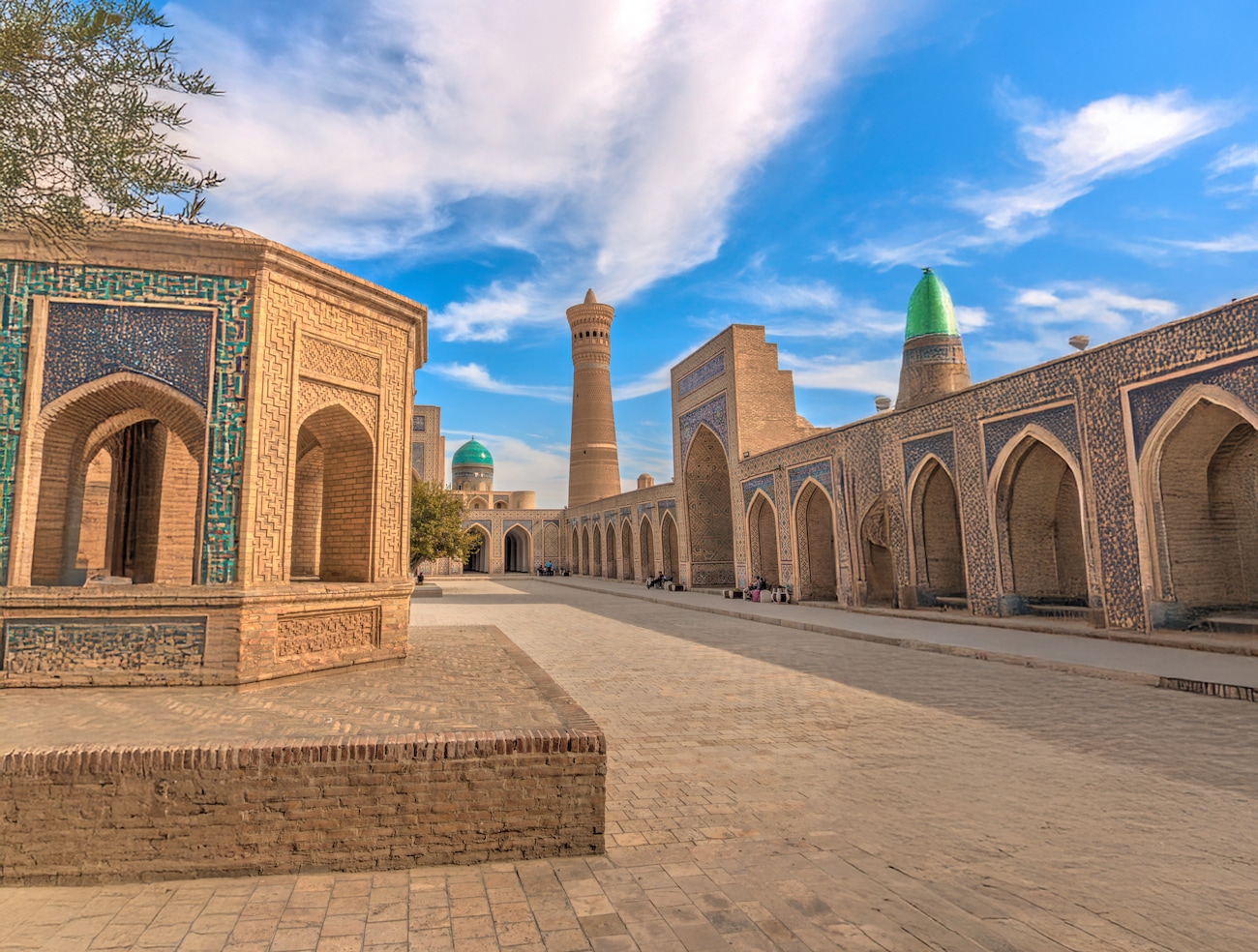
Samarkand is the name most people have vaguely heard, usually attached to the words “Silk Road” without much else behind it. The reason it has held that reputation for centuries is the Registan, a square framed on three sides by three enormous madrassas built between the 1420s and the 1660s. I have read several travel writers try to describe it and then admit the description undersells it, which is usually a sign that a place is actually worth the trip rather than just well-photographed.
The three madrassas each have their own character. The Sher-Dor is the unusual one, it has mosaics of tigers and human faces on its facade, which is genuinely rare in Islamic architecture, a tradition that almost always avoids figurative imagery. Someone broke that rule here a few centuries ago, and nobody seems to fully agree on why.
If the Registan is the postcard, Shah-i-Zinda is the place I would actually send someone who wants to feel something rather than just photograph it. It’s a street of royal tombs built up over several centuries, with tile work in blues, greens, and turquoises that genuinely looks too precise to have been done by hand. It’s less restored than the main square, which gives it a rougher, more honest feel.
There’s a difference between a monument that has been polished for visitors and one that has simply survived, and Shah-i-Zinda sits closer to the second category.
Gur-e-Amir, the tomb of the conqueror Timur, is smaller but worth the hour. Its ribbed turquoise dome is one of those architectural details that quietly travelled, you can trace its influence forward through mosques in Istanbul and all the way to the Taj Mahal in Agra. It’s a strange thing to stand in front of a 15th-century tomb in Central Asia and recognise the bones of a building you grew up seeing on an Indian rupee note.
Bukhara
Samarkand wins on sheer spectacle, but if I had to choose where to actually spend an extra night, I would pick Bukhara without much hesitation. Samarkand’s old city, for all its grandeur, increasingly exists for visitors. Bukhara’s old city is still a place people live in.
Laundry hangs out to dry two streets from a 900-year-old minaret. Shopkeepers run businesses that have nothing to do with tourism at all. That lived-in quality is harder to fake and harder to find once a heritage city tips fully into being a museum.
The Kalon Minaret anchors the place. It was built in 1127, and there’s a story, possibly true, possibly just good storytelling passed down for eight centuries, that when Genghis Khan’s forces destroyed Bukhara in 1220, he looked up at the minaret and ordered it spared, the only structure he is said to have ever shown that respect to. True or not, the minaret is still standing nine hundred years later, which is its own kind of proof.
My favourite detail, though, is Lyabi-Hauz, a 17th-century pool in the centre of the old city, ringed by mulberry trees and open-air teahouses. In the evenings, the day-trippers leave and the square fills with families instead, kids running around, older men playing chess over tea that takes longer to finish than the game does. It’s the kind of place that tells you more about a country in twenty quiet minutes than most monuments manage in an hour.
Khiva
Khiva is the one people are most tempted to skip, mostly because it’s the hardest to reach, a 30-minute taxi from the nearest airport at Urgench, or a long overland leg from Bukhara. Skipping it would be a mistake. The inner walled city, Ichon-Qala, is one of the most completely preserved historic urban centres anywhere in the world. The walls, minarets, mosques, and old caravanserais are all still standing, intact enough that the whole place can feel almost too perfectly preserved to be real.
The detail that stuck with me is the Kalta Minor, a short, squat, deliberately unfinished turquoise minaret. It was meant to be the tallest minaret in the world, until the khan who commissioned it died mid-construction in 1855 and nobody ever picked the project back up. It has sat there, half-built, for a hundred and seventy years, and somehow looks more striking for being incomplete than most finished monuments manage.
A country worth its own trip
None of this connects to the Trans-Siberian Explorer in any direct sense, and I want to be honest about that rather than force a link that isn’t there. What it does tell me is something about how research works, and maybe about how discovery works for travellers generally.
You go looking for one thing, in this case a railway through Siberia, and you stumble into a country that has quietly opened its doors, fixed its infrastructure, and still has its biggest square nearly empty on a Tuesday morning. That combination, genuine history, real accessibility, and very little competition for your attention while you are standing in front of it, doesn’t last forever once word gets out.
I went looking for a train through Mongolia. I came back with a country I now want to send people to before everyone else figures out.
Know the Unknown
As you have probably figured out by now, I love doing research. We launched flight bookings on veenaworld.com this past week, and going down that particular rabbit hole, looking at routes all over the world, is how I came across this one.
Take off from Sydney at lunchtime. Land in Los Angeles at breakfast. Same day. You read that correctly. You fly through the night for roughly fourteen hours across the Pacific, and you touch down in LA earlier on the clock than when you left Sydney. You arrive before you departed.
It isn't a trick. Somewhere over the ocean, the flight crosses the International Date Line, and you effectively get an entire day handed back to you. Los Angeles runs about seventeen hours behind Sydney, so for the length of that flight, you are more or less flying backwards through time. It's the closest thing to a real rewind button I have come across in this job.
If you can think of another route that plays the same trick, write in and tell me. I'm always looking for the next one. See you next week…






 86 videos












Post your Comment
Please let us know your thoughts on this story by leaving a comment.