



Published in Indian Express. Date 24th May, 2026
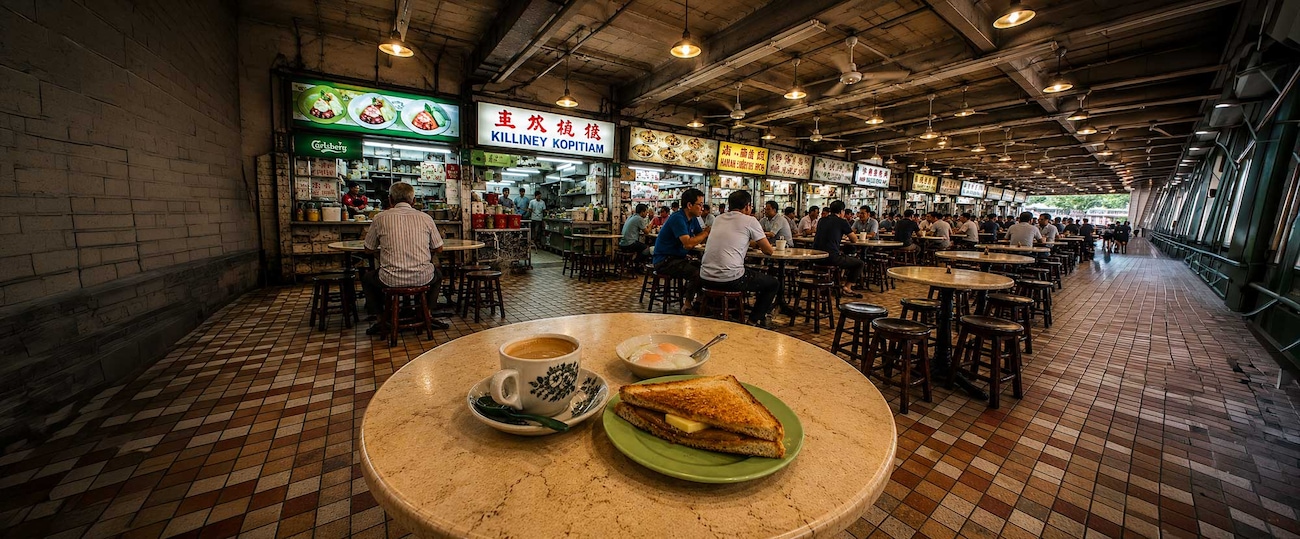
Of all the meals I have had while travelling, the one I return to most often costs less than two Singapore dollars. It is a breakfast. Kopi, Singapore's distinctive, richly brewed coffee, made with robusta beans roasted with butter and sugar, served in a ceramic cup almost too hot to hold, and kaya toast. Two thin slices of bread, toasted over a charcoal fire, spread with kaya, a jam made from coconut milk, eggs, and pandan leaves, with a small knob of cold butter placed between them. On the side, two soft-boiled eggs, barely set, into which you dip the toast before eating.
I describe this carefully because eating it at a hawker centre in Singapore at seven in the morning is an experience I have thought about almost every week since. There is nothing glamorous about it. No dress code, no reservation, no printed menu. You walk up to the stall, you point at what you want, you carry it yourself to a table, and you eat. And somehow, it is one of the best things I have ever tasted anywhere. I want to talk about why.
When Did Food Become a Checklist?
Something has shifted in the way many of us plan our food experiences while travelling. A few years ago, deciding where to eat meant asking the hotel concierge, following a recommendation from a local, or simply walking until something smelled good. Today, most of us arrive at a destination with a list already open on our phones. The Michelin-starred spots. The viral café from Instagram. The tasting menu booked months in advance. The problem is not the list. The problem is that when every meal is pre-decided, you stop wandering. And when you stop wandering, you stop discovering. You leave little room for instinct, appetite or the kind of accidental moments that often become the most vivid memories of a journey.
Some of the best food I have ever eaten has come from exactly that wandering. At Took Lae Dae, a fluorescent-lit diner on Sukhumvit Soi 5 in Bangkok that never closes, I sat alone at midnight eating crab meat fried rice from a wok still smoking from the heat, surrounded by Thai taxi drivers on their break. In Xi'an, I stood in a night market barely able to move for the crowd, steam rising around me, eating hand-pulled noodles so thick and dense they bore no resemblance to anything I'd called noodles before. In Hanoi, I sat on a stool so small my knees were level with my chest, on a pavement so narrow the scooters clipped my shoulder as they passed, eating bún chả with friends at eleven at night, unable to stop laughing, unable to stop eating. In Tasmania, I pulled over at a roadside oyster farm on a whim and ate a dozen oysters so fresh they still tasted of the sea they had come from an hour before. None of these were on a list. Not one was researched, reviewed, or recommended by anyone. And they are the meals I remember most clearly from every trip I have ever taken.
What a Michelin Star Actually Is
Before I go further, it is worth understanding where the Michelin star actually comes from, because the origin story matters. The Michelin Guide was created in France in 1900, not by a chef or food critic, but by the Michelin tyre company. The idea was simple: give French motorists a guidebook to help them travel further, where to eat, where to sleep, and where to find petrol. The more people drove, the more tyres they would buy. The guide was, at its origin, a marketing exercise.
Over the decades, the food section evolved into something far more serious. Anonymous inspectors. Rigorous standards. The now-famous star system, with three stars becoming one of the highest honours in global dining. Across the world today, only a little more than 150 restaurants hold three Michelin stars, making it one of the most selective distinctions in hospitality.
I explain this not to diminish the achievement, but because the guide’s origin as a tool to make people travel more is, I think, the most honest version of what a great food guide should do. It should send you somewhere new. It should make you move. The danger is when it becomes the destination itself.
The Soul of a City
Let me come back to Singapore's hawker centres, because they deserve more than a passing mention. A hawker centre is, on the surface, a very simple thing: an open-air food court, government-managed, with dozens of individual stalls, plastic chairs, ceiling fans, and trays you return yourself. Nothing about it resembles fine dining. No mood lighting, no sommelier, no ceremony. What there is, instead, is everything. Hainanese chicken rice perfected over four decades by the same family. Laksa that costs less than a cup of coffee in Mumbai. Char kway teow cooked over a flame so fierce the wok catches fire at the edges. And around you, eating exactly the same food, are Singaporeans of every age and background, from office-goers to grandparents, all sharing a ritual that feels both deeply personal and unmistakably communal.
Here is the detail that matters most: two of Singapore's hawker stalls have been awarded Michelin stars. Hawker Chan on Smith Street, and Hill Street Tai Hwa Pork Noodle, both operating with plastic chairs, shared tables, and no printed menu, both now holding one of the most coveted food accolades in the world. The Michelin Guide itself recognises that extraordinary food does not require a grand setting. But beyond the stars, hawker centres are where Singapore's culture lives. They are where the city's history, its waves of Chinese, Malay, Indian, and Peranakan immigration, shows up most honestly on a plate. You cannot truly understand Singapore without sitting in one. No hotel restaurant, however beautifully designed, will show you the same thing.
This principle holds almost everywhere. In Japan, a convenience store, a 7-Eleven or a Lawson, will surprise you in ways you are not expecting. The egg salad sandwiches, the onigiri, the items at the hot foods counter: these are not afterthoughts. They are excellent, and they are what millions of Japanese people eat every day. Filter coffee at a small Udupi restaurant in Chennai. Vada pav from a cart outside Chhatrapati Shivaji Maharaj Terminus in Mumbai. These are not lesser versions of fine dining. They are irreplaceable expressions of a city's character, the food that the city chose for itself, every morning, over generations. The soul of a place is almost always found where its people actually eat.
Why the Same Food Tastes Different
There is a question worth sitting with: why does a simple meal, a bowl of noodles, a piece of toast, a cup of coffee, become unforgettable when eaten while travelling, in a way it almost never does at home? The answer has very little to do with the food. It has almost everything to do with arrival. That kopi and kaya toast in Singapore tasted the way it did because I had no plan and no reservation, and had simply walked until I was hungry. Because the city still felt enormous and new. Because I was paying attention in a way that routine makes impossible. Travel compresses your senses. It makes you notice things, the temperature of a ceramic cup, the sound of a ceiling fan, the texture of charcoal-toasted bread, and even the quiet rhythm of people around you, details you would likely sleepwalk through at home.
A booked restaurant cannot manufacture that. What it manufactures instead is anticipation, which is a different and smaller thing. The meals we remember most from travel are almost never the ones we planned most carefully. They are the ones that found us, unexpectedly, in moments when we were fully present and open to the place around us.
Stars Are Not the Problem
I want to be clear, because this argument is easily misread. Michelin-starred restaurants are genuinely extraordinary places. The best chefs in the world work with a level of obsessiveness and craft that deserves real respect. A great tasting menu can feel like theatre, technique and flavour working together at a pitch that casual dining simply cannot reach. I have eaten in fine dining restaurants that I remember as vividly as any hawker stall.
The issue is not fine dining. The issue is travelling as though fine dining is the only thing worth seeking. When you plan a four-day trip to Paris and every meal is pre-booked at a named restaurant, you have decided, before you arrived, what Paris will taste like to you. You have traded the possibility of surprise for the comfort of certainty. And in doing so, you have given up the one thing that no restaurant, however brilliant, can put on its menu: the chance encounter, the unplanned detour, the unexpected discovery that often becomes the most lasting memory of all. The best food trips I have taken share a simple structure: one or two reservations for places I genuinely wanted to experience, and everything else left open. Permission to go nowhere in particular and see what I found. That gap, that open evening with no plan, is where the real meals live.
What You Actually Bring Home
Years later, we rarely remember the price of a meal, the precision of the plating, or the clever wording on the menu. What stays with us is the feeling of being completely present in a particular place, because something on the table surprised us, comforted us, or tasted unmistakably of the destination we had travelled so far to experience. The best souvenir from any trip is usually not something you packed into your suitcase. It is a taste that returns to you years later without warning. It is the memory of exactly where you were sitting, who you were with, what conversation was unfolding, and how the light looked when that plate arrived. Sometimes a single bite can bring back an entire journey more vividly than any photograph.
For me, it is a cup of kopi and two slices of kaya toast in Singapore. A plastic table. A ceiling fan turning slowly in the heat. The soft noise of morning conversations. Singapore at seven o’clock, when the city was already awake and I had nowhere to be except exactly where I was. I have eaten in some beautiful restaurants since. They were elegant, inventive and memorable in their own way. But I do not think about them as often. The meals that endure are usually the simplest ones, discovered unexpectedly and remembered not because they were expensive, but because they felt deeply connected to the place itself. See you next week…





 83 videos









Post your Comment
Please let us know your thoughts on this story by leaving a comment.