


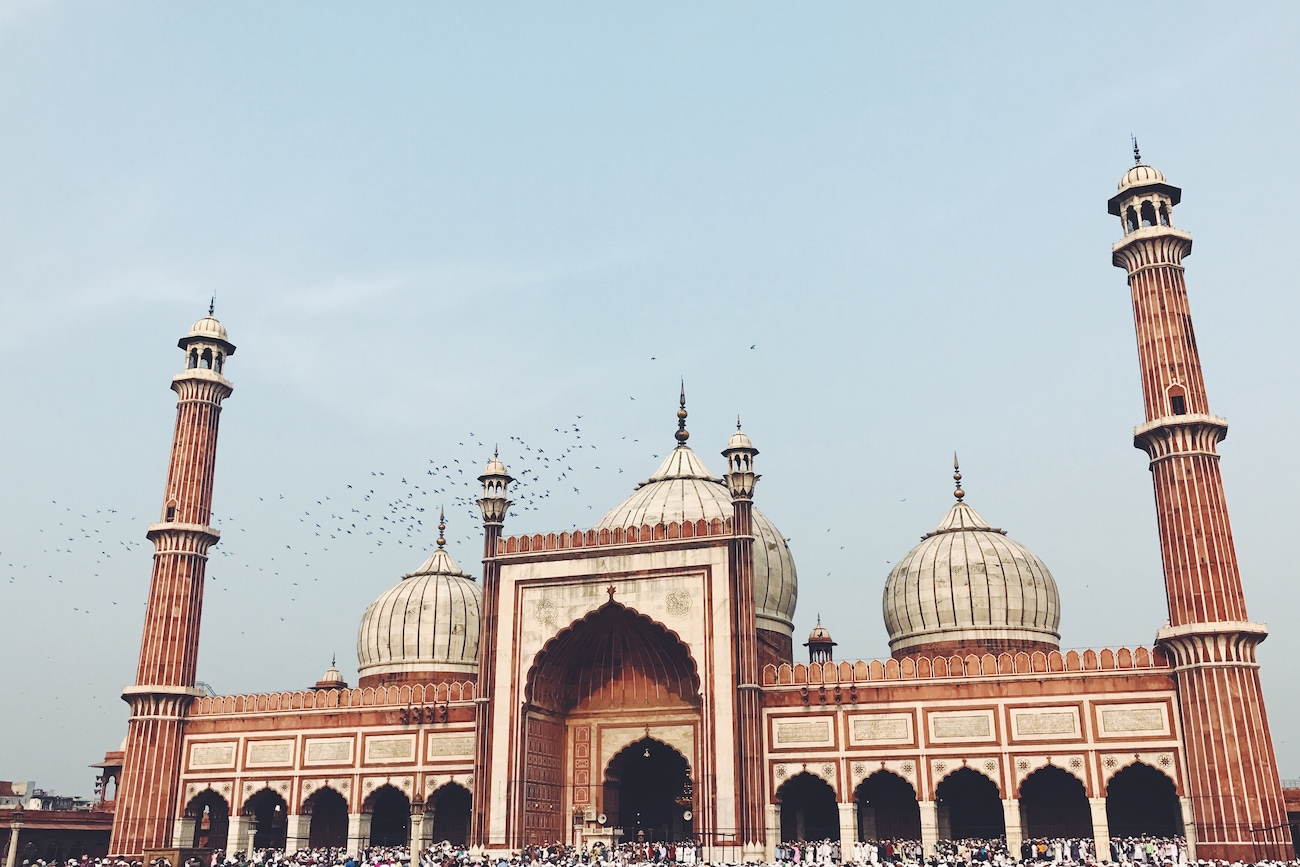

Cover Photo by Suhail Suri
When you think of historic places in Delhi for a cultural trip, Jama Masjid is a name that always comes on the list. It is, after all, one of the most famous sites in the National Capital that people from near and far come to visit. Jama Masjid is one of the biggest mosques in India which has a capacity of holding 25,000 people in the prayer hall at once.
Standing tall as one of the most historically significant structures in Old Delhi, Jama Masjid is the perfect example of the brilliance of Mughal architecture. The mosque was commissioned by Shah Jahan, the fifth Mughal ruler of India. The construction of the mosque started in 1650 and took six years to complete. The approximate expenditure was one million Indian rupees, and five thousand hands worked together to complete the mosque. The project was completed in 1656 and was inaugurated by Imam Syed Abdul Ghafoor Shah Bukhari, from Bukhara, Uzbekistan, who was appointed the first Imam of the masjid.
The mosque is also called the Masjid-i Jahanuma, or 'the mosque commanding a view of the world,' as it is atop a natural hillock. The name ‘Jama’ is derived from the word 'Jummah', referring to the congregational prayer observed by Muslims on Fridays. Due to its grand size, Jama Masjid Delhi is often regarded to have the ideal design among all Indian mosques.
History
In 1638, Shah Jahan decided to make Delhi the capital of his empire and thus relocated from Agra to Delhi, which was at that time called Shahjahanabad, located on the eastern bank of Yamuna. He constructed the Red Fort on the northeastern side of the city and placed this Mughal mosque about 500 meters to its west.
Jama Masjid has two main parts which resemble the earlier congregational mosques in Delhi - the main prayer hall and a large courtyard towards the east from the main prayer hall. The exterior of the Jama Masjid was inspired by the Akbar’s mosque at Fatehpur Sikri, whereas the interior was moulded after the Friday Mosque at Agra.
Architecture
Jama Masjid, Delhi is a 261-feet-tall structure with a width of 90 feet. It is surrounded by a 30-metre-wide lawn which separates it from the dense city and nearby fabric of roads. As it is built on a hillock, it is approximately at an elevation of 10 meters from the city level.
Jama Masjid truly reflects the grandeur of typical Shah Jahan architecture and was one of the greatest mosques constructed in its time. It is built using red sandstone and white marbles and follows Indo-Islamic and Mughal styles of architecture. The main structures at the mosque are three arched gates, three marble domes, four towers, and two towering minarets.
The Three Archways
The three archways are built using red sandstone and provide access to the corridor and the prayer hall on the western side of the corridor. They are situated on the north, south, and east sides. The eastern gate has 35 steps leading to it. It is the largest gate at Jama Masjid, Delhi and was used by the royal family. The north and south gates are the ones open for use by visitors and have 39 and 33 steps, respectively. The steps have white markings which point towards the direction in which the prayers are offered.
The Two Minarets
The two minarets are quite identical in appearance. Both of the minarets are five storeys tall and go as high as 130 feet. There are 130 steps inside each minaret. Both the minarets have protruding balconies.
The Floor
The Jama Masjid of Delhi is built by taking the design of Agra’s Jama Masjid as inspiration. Because of this, the floor plans of both mosques are quite similar. There are 899 boxes designed on the floor in white and black marble to resemble a Muslim praying mat.
The mosque complex comprises a square corridor (approximately 115 meters square). The main shrine (approximately 70 meters north-south by 25 meters east-west) is located along the western edge of the corridor.
These are the main details about Jama Masjid, Delhi’s architecture. For the inquisitive souls, there are many more intricacies to explore. Those who are still curious about the design of the mosque may plan a one-day visit to it and explore the same.
Timings
The largest mosque in Delhi is open every day of the week. However, the timings are somewhat limited. The mosque is open from 7 am to 12 pm and from 1:30 pm to 6:30 pm. Tourists are not allowed during prayer hours. The minaret is open from 9 am to 5:30 pm.
Entry Fee
Entry to the mosque is free; however, you will have to pay Rs 100 to visit the minaret. Additionally, if you are bringing a camera, you will have to pay an extra amount of Rs 300.
How to Reach
The location of Jama Masjid in Delhi is quite easy to access by both public and personal transport. Located near Chandni Chowk of Old Delhi, one can book a cab or drive up to the mosque. Alternatively, they can travel by metro and get down at Jama Masjid Metro Station on the Violet Line. Shared transport options such as bus, auto, and tuk-tuks are also available to travel to Jama Masjid.
Things to Do Nearby
Jama Masjid is famous for more than just the mosque. Hundreds of people flock to Jama Masjid to explore the scrumptious non-vegetarian delicacies served here, making it a top picnic spot in Delhi. On a trip to Jama Masjid, here’s what you can do nearby:
- Have lunch at Aslam Chicken Corner or enjoy kebabs at Qureshi’s
- Shop for wedding items at Kinari Bazaar
- Go to Nai Sadak to find new books
- Visit Khari Baoli to buy traditional spices
- Explore Red Fort, another specimen of brilliant Shah Jahan architecture
- Stroll through Chandni Chowk market
When planned right, a trip to Jama Masjid can turn into a mini-tour of the place itself along with the sights and sounds that complement it. Think of it as a culture trip that will delight your senses, amaze the explorer in you, and give enough food for the soul – spare ample time to make sure that you make the best of it.







 83 videos















Post your Comment
Please let us know your thoughts on this story by leaving a comment.